


Key Insights
The Automotive Driver State Monitoring Systems (DSM) market is poised for significant expansion, projecting a market size of $2.93 billion in 2025, with a robust Compound Annual Growth Rate (CAGR) of 8.6%. This growth is fundamentally driven by an escalating focus on vehicle safety and the increasing integration of advanced driver-assistance systems (ADAS) in both passenger cars and commercial vehicles. Regulatory mandates and consumer demand for enhanced protection are compelling automakers to implement DSM technologies, which continuously monitor driver alertness and behavior to prevent accidents caused by fatigue, distraction, or impairment. The market’s trajectory is further bolstered by technological advancements in sensor technology, sophisticated camera systems, and the development of more integrated solutions, including crash-resistant steel cabins that enhance overall vehicle safety.
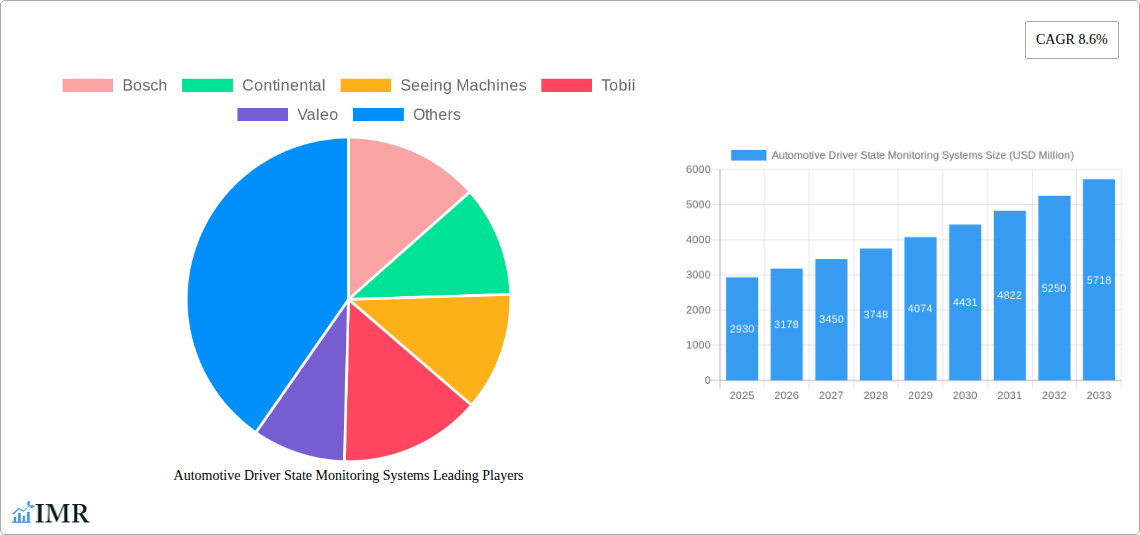
Automotive Driver State Monitoring Systems Market Size (In Billion)

Key trends shaping the DSM landscape include the miniaturization of sensors, the development of AI-powered algorithms for more accurate driver state detection, and the increasing adoption of eye-tracking and facial recognition technologies. These innovations enable systems to differentiate between normal driving behavior and critical deviations, offering timely alerts. The market is segmenting effectively with strong adoption across Passenger Cars and Commercial Vehicles. On the technology front, Sensors and Cameras are leading the way, with growing interest in integrated solutions. Major global players such as Bosch, Continental, Seeing Machines, Tobii, Valeo, and Visteon are actively investing in research and development, fostering a competitive environment that accelerates innovation and market penetration. While the market shows immense promise, challenges such as the high cost of advanced DSM integration and potential data privacy concerns need to be addressed to ensure widespread adoption and sustained growth.
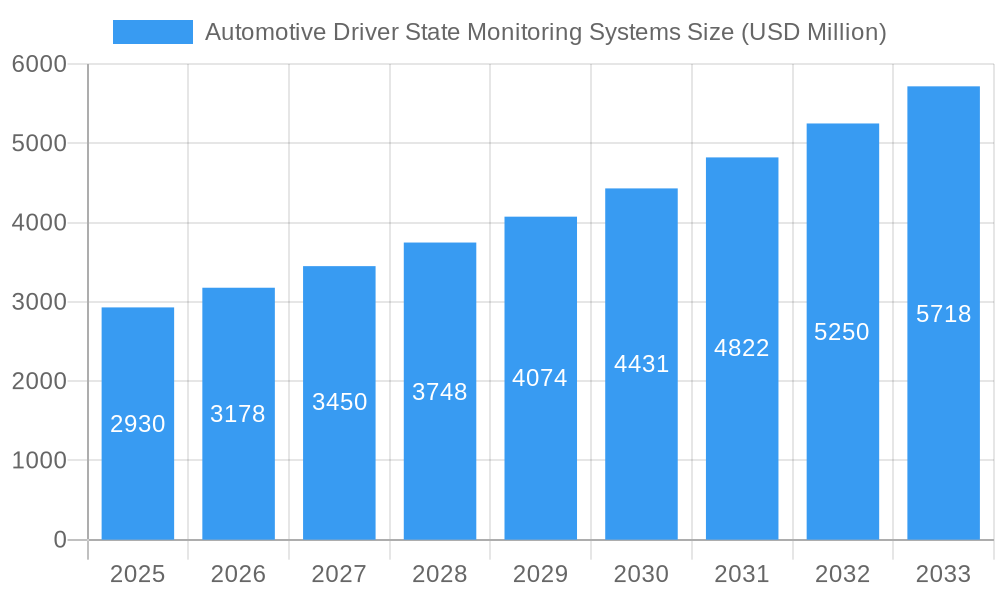
Automotive Driver State Monitoring Systems Company Market Share
Automotive Driver State Monitoring Systems Market Dynamics & Structure
The Automotive Driver State Monitoring (DSM) Systems market is characterized by a moderately concentrated landscape, driven by intense technological innovation and evolving regulatory frameworks. Key players like Bosch, Continental, Seeing Machines, and Valeo are at the forefront, investing heavily in advanced AI-driven algorithms for real-time driver attention, fatigue, and distraction detection. The parent market, encompassing the broader automotive safety systems, provides a robust foundation, while the child market for DSM specifically is experiencing rapid growth fueled by mandates and voluntary safety feature adoptions.
- Technological Innovation Drivers: Advancements in AI, computer vision, sensor fusion, and in-cabin sensor technology are pivotal. The development of unobtrusive and accurate driver monitoring solutions is a key focus.
- Regulatory Frameworks: Increasing government mandates for driver safety features, particularly in Europe (e.g., GSR 2) and emerging economies, are significantly shaping market penetration.
- Competitive Product Substitutes: While direct substitutes are limited, traditional driver alerts (e.g., audible warnings) and semi-autonomous driving features that reduce driver workload can be seen as indirect competitive pressures.
- End-User Demographics: Growing awareness among consumers regarding vehicle safety, coupled with an increasing preference for advanced driver-assistance systems (ADAS), drives demand. Fleet operators in the commercial vehicle segment are also significant adopters due to safety and operational efficiency concerns.
- M&A Trends: Strategic acquisitions and partnerships are prevalent as larger automotive suppliers aim to integrate comprehensive DSM solutions into their offerings and smaller, specialized technology firms seek market access and funding. For instance, mergers and acquisitions in the historical period (2019-2024) indicate a consolidation trend, with approximately 5-7 significant M&A deals valued at over $500 million each within the broader ADAS and DSM space.
Automotive Driver State Monitoring Systems Growth Trends & Insights
The Automotive Driver State Monitoring (DSM) Systems market is poised for substantial expansion, driven by a confluence of technological advancements, regulatory mandates, and a heightened global focus on road safety. The parent market for automotive electronics and safety systems provides a fertile ground for DSM adoption, with the child market for DSM systems emerging as a critical sub-segment. Projections indicate a robust Compound Annual Growth Rate (CAGR) of xx% over the forecast period (2025-2033), propelling the market size from an estimated \$5.2 billion in the base year (2025) to over \$15.5 billion by 2033. This significant growth is underpinned by increasing integration of DSM as a standard feature across various vehicle segments, moving beyond premium offerings.
Technological disruptions are at the heart of this market's evolution. The refinement of AI algorithms for precise driver behavior analysis, including fatigue detection, distraction identification, and even health monitoring, is a key catalyst. Camera-based systems, leveraging sophisticated computer vision, are becoming more prevalent, complemented by advancements in infrared sensors for enhanced performance in low-light conditions. The adoption rate of DSM systems is accelerating, particularly within new vehicle platforms, as manufacturers recognize their critical role in achieving higher safety ratings and complying with evolving regulations. Consumer behavior is also shifting; as drivers become more aware of the risks associated with fatigue and distraction, they increasingly seek vehicles equipped with these advanced safety technologies. Furthermore, the expanding commercial vehicle sector, driven by the need to enhance fleet safety and reduce operational risks, represents a significant growth avenue, with specialized DSM solutions tailored for heavy-duty applications. The shift towards greater automation in vehicles also necessitates sophisticated DSM to ensure driver supervision and readiness to take over control, further solidifying its importance.
Dominant Regions, Countries, or Segments in Automotive Driver State Monitoring Systems
The dominance within the Automotive Driver State Monitoring (DSM) Systems market is currently consolidated within the Passenger Cars application segment, representing a significant share of the overall market value, estimated at around 65-70% in the base year 2025. This segment's leadership is propelled by robust consumer demand for advanced safety features, stringent safety regulations in key automotive markets, and the increasing integration of DSM as a standard or optional feature across a wide spectrum of passenger vehicles, from compact cars to luxury SUVs. The parent market of passenger vehicles globally forms the bedrock of this dominance, while the child market for DSM in passenger cars is the immediate driver.
Key Drivers for Passenger Cars Dominance:
- Regulatory Mandates: The European Union's General Safety Regulation (GSR 2) has been a significant catalyst, requiring the implementation of driver monitoring systems in new vehicle types from 2022 onwards, directly impacting passenger car sales. Similar initiatives are gaining traction in other developed markets.
- Consumer Awareness and Demand: Increased public awareness of road safety issues, amplified by media coverage and safety rating programs like Euro NCAP, has created a strong consumer pull for vehicles equipped with advanced safety technologies, including DSM.
- Technological Advancements and Affordability: Continuous innovation has led to more cost-effective and sophisticated DSM solutions, making them accessible for a broader range of passenger car models. The development of miniaturized sensors and efficient AI algorithms has reduced system costs.
- OEM Integration Strategies: Automakers are increasingly prioritizing DSM as a key selling proposition, integrating it as a standard feature in higher trim levels and offering it as an attractive option across their model lineups to enhance vehicle safety portfolios.
- Growing Per-Vehicle Value: The increasing sophistication of vehicle electronics means that safety systems like DSM contribute to a higher per-vehicle revenue for OEMs, further incentivizing their adoption.
Regional Leadership: Europe currently leads in DSM adoption due to its strong regulatory push and high consumer awareness regarding vehicle safety. North America follows closely, with a growing emphasis on ADAS features and a significant market for premium vehicles. Asia-Pacific is emerging as a rapidly growing region, driven by increasing disposable incomes, growing vehicle production, and a gradual implementation of safety regulations.
Automotive Driver State Monitoring Systems Product Landscape
The product landscape of Automotive Driver State Monitoring (DSM) Systems is characterized by a rapid evolution of sensor technologies and intelligent algorithms. Integrated camera systems, utilizing visible and infrared light, are becoming standard, offering robust performance in diverse lighting conditions. Advanced algorithms powered by artificial intelligence are now capable of not only detecting eye gaze and blink patterns but also recognizing head pose and physiological indicators of fatigue and distraction. Innovations are focused on non-intrusive driver monitoring, miniaturization of components, and enhanced data processing capabilities to enable real-time alerts and interventions.
Key Drivers, Barriers & Challenges in Automotive Driver State Monitoring Systems
Key Drivers:
- Stringent safety regulations worldwide, mandating driver monitoring systems for enhanced road safety, are a primary growth propeller.
- Rising consumer demand for advanced safety features and a growing awareness of the dangers of driver fatigue and distraction.
- Technological advancements in AI, computer vision, and in-cabin sensors are enabling more accurate and cost-effective DSM solutions.
- OEM commitment to improving vehicle safety ratings and differentiating their product offerings with cutting-edge ADAS, including DSM.
Barriers & Challenges:
- High initial development and integration costs for OEMs and tier-1 suppliers can be a restraint, especially for mass-market adoption.
- Privacy concerns among consumers regarding the collection and use of in-cabin data can pose a challenge to widespread acceptance and implementation.
- Technical limitations such as performance degradation in extreme weather conditions or for drivers wearing glasses or masks, requiring continuous innovation.
- Interoperability and standardization issues across different vehicle platforms and sensor manufacturers can hinder seamless integration.
- Supply chain disruptions and the availability of critical components, especially semiconductors, can impact production volumes.
Emerging Opportunities in Automotive Driver State Monitoring Systems
Emerging opportunities in Automotive Driver State Monitoring (DSM) systems lie in the expanding integration of DSM into commercial vehicle fleets for improved safety and operational efficiency. The development of advanced driver health monitoring capabilities, detecting conditions like micro-sleeps or even early signs of medical emergencies, presents a significant untapped market. Furthermore, the convergence of DSM with augmented reality (AR) heads-up displays (HUDs) to provide driver-centric information and alerts offers a novel application. The growth of ride-sharing and autonomous vehicle development also creates opportunities for sophisticated driver and occupant monitoring solutions.
Growth Accelerators in the Automotive Driver State Monitoring Systems Industry
Long-term growth in the Automotive Driver State Monitoring (DSM) Systems industry will be significantly accelerated by continuous advancements in artificial intelligence and machine learning, enabling more precise and predictive driver behavior analysis. Strategic partnerships between technology providers and established automotive OEMs will foster wider adoption and faster integration of DSM into new vehicle models. The increasing focus on data-driven safety insights, allowing for personalized driver coaching and fleet management, will also act as a powerful growth catalyst. Furthermore, the gradual rollout of Level 3 and Level 4 autonomous driving systems will necessitate robust DSM solutions to ensure driver supervision and a seamless handover of control.
Key Players Shaping the Automotive Driver State Monitoring Systems Market
- Bosch
- Continental
- Seeing Machines
- Tobii
- Valeo
- Visteon
- Aisin Seiki
- Autoliv
- Delphi Automotive
- DENSO
- EDGE3 Technologies
- Panasonic
- Samsung Electronics
- Hyundai Mobis
- Jungo Connectivity
- Magna
- Osram Opto Semiconductors
Notable Milestones in Automotive Driver State Monitoring Systems Sector
- 2019-2020: Increased deployment of basic driver alert systems (e.g., fatigue warnings) in premium passenger cars.
- 2020-2021: Advancements in AI algorithms leading to more accurate detection of driver distraction and drowsiness.
- 2021-2022: European Union's General Safety Regulation 2 (GSR 2) implementation begins, mandating driver monitoring for new vehicle types.
- 2022-2023: Growing integration of in-cabin cameras with infrared capabilities for enhanced performance in all lighting conditions.
- 2023-2024: Strategic partnerships emerge between DSM technology providers and major automotive OEMs for integrated ADAS solutions. Focus on developing solutions for crash-resistant steel cabins in commercial vehicles.
In-Depth Automotive Driver State Monitoring Systems Market Outlook
The future of the Automotive Driver State Monitoring (DSM) Systems market is exceptionally bright, driven by the convergence of regulatory tailwinds, technological breakthroughs, and evolving consumer expectations. The market is set to witness accelerated adoption across all vehicle segments, fueled by the indispensable role DSM plays in achieving higher safety standards and the ongoing development of autonomous driving capabilities. Continued innovation in AI-powered analytics and sensor fusion will unlock new functionalities, such as real-time driver health monitoring and predictive safety interventions. Strategic collaborations and a focus on data security and privacy will be crucial for sustained growth and market penetration, solidifying DSM as a core component of modern vehicle safety architectures.
Automotive Driver State Monitoring Systems Segmentation
-
1. Application
- 1.1. Passenger Cars
- 1.2. Commercial Vehicle
-
2. Types
- 2.1. Sensors
- 2.2. Camera
- 2.3. Crash Resistant Steel Cabins
Automotive Driver State Monitoring Systems Segmentation By Geography
-
1. North America
- 1.1. United States
- 1.2. Canada
- 1.3. Mexico
-
2. South America
- 2.1. Brazil
- 2.2. Argentina
- 2.3. Rest of South America
-
3. Europe
- 3.1. United Kingdom
- 3.2. Germany
- 3.3. France
- 3.4. Italy
- 3.5. Spain
- 3.6. Russia
- 3.7. Benelux
- 3.8. Nordics
- 3.9. Rest of Europe
-
4. Middle East & Africa
- 4.1. Turkey
- 4.2. Israel
- 4.3. GCC
- 4.4. North Africa
- 4.5. South Africa
- 4.6. Rest of Middle East & Africa
-
5. Asia Pacific
- 5.1. China
- 5.2. India
- 5.3. Japan
- 5.4. South Korea
- 5.5. ASEAN
- 5.6. Oceania
- 5.7. Rest of Asia Pacific
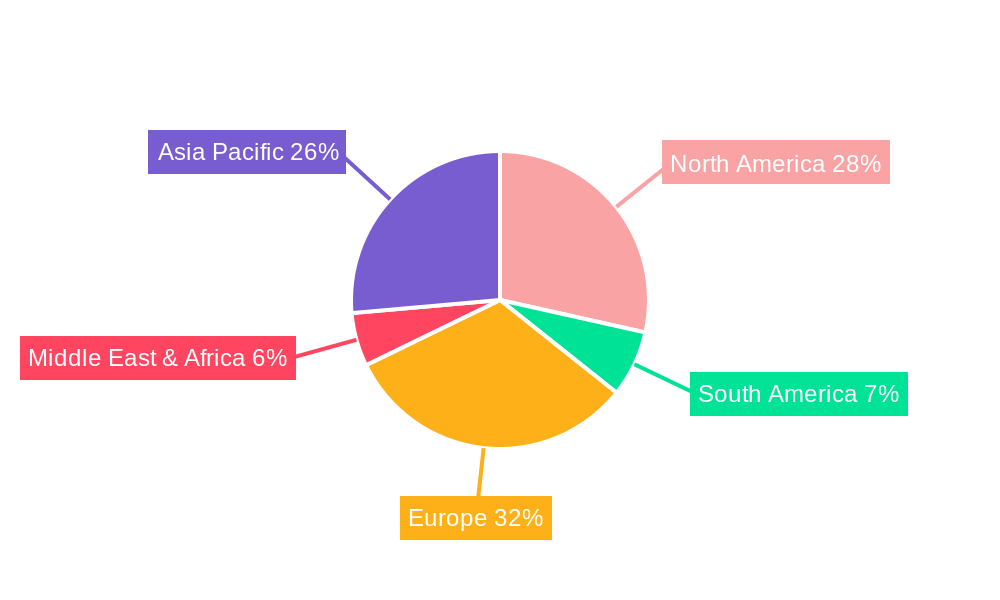
Automotive Driver State Monitoring Systems Regional Market Share
Geographic Coverage of Automotive Driver State Monitoring Systems
Automotive Driver State Monitoring Systems REPORT HIGHLIGHTS
| Aspects | Details |
|---|---|
| Study Period | 2020-2034 |
| Base Year | 2025 |
| Estimated Year | 2026 |
| Forecast Period | 2026-2034 |
| Historical Period | 2020-2025 |
| Growth Rate | CAGR of 8.6% from 2020-2034 |
| Segmentation |
|
Table of Contents
- 1. Introduction
- 1.1. Research Scope
- 1.2. Market Segmentation
- 1.3. Research Methodology
- 1.4. Definitions and Assumptions
- 2. Executive Summary
- 2.1. Introduction
- 3. Market Dynamics
- 3.1. Introduction
- 3.2. Market Drivers
- 3.3. Market Restrains
- 3.4. Market Trends
- 4. Market Factor Analysis
- 4.1. Porters Five Forces
- 4.2. Supply/Value Chain
- 4.3. PESTEL analysis
- 4.4. Market Entropy
- 4.5. Patent/Trademark Analysis
- 5. Global Automotive Driver State Monitoring Systems Analysis, Insights and Forecast, 2020-2032
- 5.1. Market Analysis, Insights and Forecast - by Application
- 5.1.1. Passenger Cars
- 5.1.2. Commercial Vehicle
- 5.2. Market Analysis, Insights and Forecast - by Types
- 5.2.1. Sensors
- 5.2.2. Camera
- 5.2.3. Crash Resistant Steel Cabins
- 5.3. Market Analysis, Insights and Forecast - by Region
- 5.3.1. North America
- 5.3.2. South America
- 5.3.3. Europe
- 5.3.4. Middle East & Africa
- 5.3.5. Asia Pacific
- 5.1. Market Analysis, Insights and Forecast - by Application
- 6. North America Automotive Driver State Monitoring Systems Analysis, Insights and Forecast, 2020-2032
- 6.1. Market Analysis, Insights and Forecast - by Application
- 6.1.1. Passenger Cars
- 6.1.2. Commercial Vehicle
- 6.2. Market Analysis, Insights and Forecast - by Types
- 6.2.1. Sensors
- 6.2.2. Camera
- 6.2.3. Crash Resistant Steel Cabins
- 6.1. Market Analysis, Insights and Forecast - by Application
- 7. South America Automotive Driver State Monitoring Systems Analysis, Insights and Forecast, 2020-2032
- 7.1. Market Analysis, Insights and Forecast - by Application
- 7.1.1. Passenger Cars
- 7.1.2. Commercial Vehicle
- 7.2. Market Analysis, Insights and Forecast - by Types
- 7.2.1. Sensors
- 7.2.2. Camera
- 7.2.3. Crash Resistant Steel Cabins
- 7.1. Market Analysis, Insights and Forecast - by Application
- 8. Europe Automotive Driver State Monitoring Systems Analysis, Insights and Forecast, 2020-2032
- 8.1. Market Analysis, Insights and Forecast - by Application
- 8.1.1. Passenger Cars
- 8.1.2. Commercial Vehicle
- 8.2. Market Analysis, Insights and Forecast - by Types
- 8.2.1. Sensors
- 8.2.2. Camera
- 8.2.3. Crash Resistant Steel Cabins
- 8.1. Market Analysis, Insights and Forecast - by Application
- 9. Middle East & Africa Automotive Driver State Monitoring Systems Analysis, Insights and Forecast, 2020-2032
- 9.1. Market Analysis, Insights and Forecast - by Application
- 9.1.1. Passenger Cars
- 9.1.2. Commercial Vehicle
- 9.2. Market Analysis, Insights and Forecast - by Types
- 9.2.1. Sensors
- 9.2.2. Camera
- 9.2.3. Crash Resistant Steel Cabins
- 9.1. Market Analysis, Insights and Forecast - by Application
- 10. Asia Pacific Automotive Driver State Monitoring Systems Analysis, Insights and Forecast, 2020-2032
- 10.1. Market Analysis, Insights and Forecast - by Application
- 10.1.1. Passenger Cars
- 10.1.2. Commercial Vehicle
- 10.2. Market Analysis, Insights and Forecast - by Types
- 10.2.1. Sensors
- 10.2.2. Camera
- 10.2.3. Crash Resistant Steel Cabins
- 10.1. Market Analysis, Insights and Forecast - by Application
- 11. Competitive Analysis
- 11.1. Global Market Share Analysis 2025
- 11.2. Company Profiles
- 11.2.1 Bosch
- 11.2.1.1. Overview
- 11.2.1.2. Products
- 11.2.1.3. SWOT Analysis
- 11.2.1.4. Recent Developments
- 11.2.1.5. Financials (Based on Availability)
- 11.2.2 Continental
- 11.2.2.1. Overview
- 11.2.2.2. Products
- 11.2.2.3. SWOT Analysis
- 11.2.2.4. Recent Developments
- 11.2.2.5. Financials (Based on Availability)
- 11.2.3 Seeing Machines
- 11.2.3.1. Overview
- 11.2.3.2. Products
- 11.2.3.3. SWOT Analysis
- 11.2.3.4. Recent Developments
- 11.2.3.5. Financials (Based on Availability)
- 11.2.4 Tobii
- 11.2.4.1. Overview
- 11.2.4.2. Products
- 11.2.4.3. SWOT Analysis
- 11.2.4.4. Recent Developments
- 11.2.4.5. Financials (Based on Availability)
- 11.2.5 Valeo
- 11.2.5.1. Overview
- 11.2.5.2. Products
- 11.2.5.3. SWOT Analysis
- 11.2.5.4. Recent Developments
- 11.2.5.5. Financials (Based on Availability)
- 11.2.6 Visteon
- 11.2.6.1. Overview
- 11.2.6.2. Products
- 11.2.6.3. SWOT Analysis
- 11.2.6.4. Recent Developments
- 11.2.6.5. Financials (Based on Availability)
- 11.2.7 Aisin Seiki
- 11.2.7.1. Overview
- 11.2.7.2. Products
- 11.2.7.3. SWOT Analysis
- 11.2.7.4. Recent Developments
- 11.2.7.5. Financials (Based on Availability)
- 11.2.8 Autoliv
- 11.2.8.1. Overview
- 11.2.8.2. Products
- 11.2.8.3. SWOT Analysis
- 11.2.8.4. Recent Developments
- 11.2.8.5. Financials (Based on Availability)
- 11.2.9 Delphi Automotive
- 11.2.9.1. Overview
- 11.2.9.2. Products
- 11.2.9.3. SWOT Analysis
- 11.2.9.4. Recent Developments
- 11.2.9.5. Financials (Based on Availability)
- 11.2.10 DENSO
- 11.2.10.1. Overview
- 11.2.10.2. Products
- 11.2.10.3. SWOT Analysis
- 11.2.10.4. Recent Developments
- 11.2.10.5. Financials (Based on Availability)
- 11.2.11 EDGE3 Technologies
- 11.2.11.1. Overview
- 11.2.11.2. Products
- 11.2.11.3. SWOT Analysis
- 11.2.11.4. Recent Developments
- 11.2.11.5. Financials (Based on Availability)
- 11.2.12 Panasonic
- 11.2.12.1. Overview
- 11.2.12.2. Products
- 11.2.12.3. SWOT Analysis
- 11.2.12.4. Recent Developments
- 11.2.12.5. Financials (Based on Availability)
- 11.2.13 Samsung Electronics
- 11.2.13.1. Overview
- 11.2.13.2. Products
- 11.2.13.3. SWOT Analysis
- 11.2.13.4. Recent Developments
- 11.2.13.5. Financials (Based on Availability)
- 11.2.14 Hyundai Mobis
- 11.2.14.1. Overview
- 11.2.14.2. Products
- 11.2.14.3. SWOT Analysis
- 11.2.14.4. Recent Developments
- 11.2.14.5. Financials (Based on Availability)
- 11.2.15 Jungo Connectivity
- 11.2.15.1. Overview
- 11.2.15.2. Products
- 11.2.15.3. SWOT Analysis
- 11.2.15.4. Recent Developments
- 11.2.15.5. Financials (Based on Availability)
- 11.2.16 Magna
- 11.2.16.1. Overview
- 11.2.16.2. Products
- 11.2.16.3. SWOT Analysis
- 11.2.16.4. Recent Developments
- 11.2.16.5. Financials (Based on Availability)
- 11.2.17 Osram Opto Semiconductors
- 11.2.17.1. Overview
- 11.2.17.2. Products
- 11.2.17.3. SWOT Analysis
- 11.2.17.4. Recent Developments
- 11.2.17.5. Financials (Based on Availability)
- 11.2.1 Bosch
List of Figures
- Figure 1: Global Automotive Driver State Monitoring Systems Revenue Breakdown (undefined, %) by Region 2025 & 2033
- Figure 2: North America Automotive Driver State Monitoring Systems Revenue (undefined), by Application 2025 & 2033
- Figure 3: North America Automotive Driver State Monitoring Systems Revenue Share (%), by Application 2025 & 2033
- Figure 4: North America Automotive Driver State Monitoring Systems Revenue (undefined), by Types 2025 & 2033
- Figure 5: North America Automotive Driver State Monitoring Systems Revenue Share (%), by Types 2025 & 2033
- Figure 6: North America Automotive Driver State Monitoring Systems Revenue (undefined), by Country 2025 & 2033
- Figure 7: North America Automotive Driver State Monitoring Systems Revenue Share (%), by Country 2025 & 2033
- Figure 8: South America Automotive Driver State Monitoring Systems Revenue (undefined), by Application 2025 & 2033
- Figure 9: South America Automotive Driver State Monitoring Systems Revenue Share (%), by Application 2025 & 2033
- Figure 10: South America Automotive Driver State Monitoring Systems Revenue (undefined), by Types 2025 & 2033
- Figure 11: South America Automotive Driver State Monitoring Systems Revenue Share (%), by Types 2025 & 2033
- Figure 12: South America Automotive Driver State Monitoring Systems Revenue (undefined), by Country 2025 & 2033
- Figure 13: South America Automotive Driver State Monitoring Systems Revenue Share (%), by Country 2025 & 2033
- Figure 14: Europe Automotive Driver State Monitoring Systems Revenue (undefined), by Application 2025 & 2033
- Figure 15: Europe Automotive Driver State Monitoring Systems Revenue Share (%), by Application 2025 & 2033
- Figure 16: Europe Automotive Driver State Monitoring Systems Revenue (undefined), by Types 2025 & 2033
- Figure 17: Europe Automotive Driver State Monitoring Systems Revenue Share (%), by Types 2025 & 2033
- Figure 18: Europe Automotive Driver State Monitoring Systems Revenue (undefined), by Country 2025 & 2033
- Figure 19: Europe Automotive Driver State Monitoring Systems Revenue Share (%), by Country 2025 & 2033
- Figure 20: Middle East & Africa Automotive Driver State Monitoring Systems Revenue (undefined), by Application 2025 & 2033
- Figure 21: Middle East & Africa Automotive Driver State Monitoring Systems Revenue Share (%), by Application 2025 & 2033
- Figure 22: Middle East & Africa Automotive Driver State Monitoring Systems Revenue (undefined), by Types 2025 & 2033
- Figure 23: Middle East & Africa Automotive Driver State Monitoring Systems Revenue Share (%), by Types 2025 & 2033
- Figure 24: Middle East & Africa Automotive Driver State Monitoring Systems Revenue (undefined), by Country 2025 & 2033
- Figure 25: Middle East & Africa Automotive Driver State Monitoring Systems Revenue Share (%), by Country 2025 & 2033
- Figure 26: Asia Pacific Automotive Driver State Monitoring Systems Revenue (undefined), by Application 2025 & 2033
- Figure 27: Asia Pacific Automotive Driver State Monitoring Systems Revenue Share (%), by Application 2025 & 2033
- Figure 28: Asia Pacific Automotive Driver State Monitoring Systems Revenue (undefined), by Types 2025 & 2033
- Figure 29: Asia Pacific Automotive Driver State Monitoring Systems Revenue Share (%), by Types 2025 & 2033
- Figure 30: Asia Pacific Automotive Driver State Monitoring Systems Revenue (undefined), by Country 2025 & 2033
- Figure 31: Asia Pacific Automotive Driver State Monitoring Systems Revenue Share (%), by Country 2025 & 2033
List of Tables
- Table 1: Global Automotive Driver State Monitoring Systems Revenue undefined Forecast, by Application 2020 & 2033
- Table 2: Global Automotive Driver State Monitoring Systems Revenue undefined Forecast, by Types 2020 & 2033
- Table 3: Global Automotive Driver State Monitoring Systems Revenue undefined Forecast, by Region 2020 & 2033
- Table 4: Global Automotive Driver State Monitoring Systems Revenue undefined Forecast, by Application 2020 & 2033
- Table 5: Global Automotive Driver State Monitoring Systems Revenue undefined Forecast, by Types 2020 & 2033
- Table 6: Global Automotive Driver State Monitoring Systems Revenue undefined Forecast, by Country 2020 & 2033
- Table 7: United States Automotive Driver State Monitoring Systems Revenue (undefined) Forecast, by Application 2020 & 2033
- Table 8: Canada Automotive Driver State Monitoring Systems Revenue (undefined) Forecast, by Application 2020 & 2033
- Table 9: Mexico Automotive Driver State Monitoring Systems Revenue (undefined) Forecast, by Application 2020 & 2033
- Table 10: Global Automotive Driver State Monitoring Systems Revenue undefined Forecast, by Application 2020 & 2033
- Table 11: Global Automotive Driver State Monitoring Systems Revenue undefined Forecast, by Types 2020 & 2033
- Table 12: Global Automotive Driver State Monitoring Systems Revenue undefined Forecast, by Country 2020 & 2033
- Table 13: Brazil Automotive Driver State Monitoring Systems Revenue (undefined) Forecast, by Application 2020 & 2033
- Table 14: Argentina Automotive Driver State Monitoring Systems Revenue (undefined) Forecast, by Application 2020 & 2033
- Table 15: Rest of South America Automotive Driver State Monitoring Systems Revenue (undefined) Forecast, by Application 2020 & 2033
- Table 16: Global Automotive Driver State Monitoring Systems Revenue undefined Forecast, by Application 2020 & 2033
- Table 17: Global Automotive Driver State Monitoring Systems Revenue undefined Forecast, by Types 2020 & 2033
- Table 18: Global Automotive Driver State Monitoring Systems Revenue undefined Forecast, by Country 2020 & 2033
- Table 19: United Kingdom Automotive Driver State Monitoring Systems Revenue (undefined) Forecast, by Application 2020 & 2033
- Table 20: Germany Automotive Driver State Monitoring Systems Revenue (undefined) Forecast, by Application 2020 & 2033
- Table 21: France Automotive Driver State Monitoring Systems Revenue (undefined) Forecast, by Application 2020 & 2033
- Table 22: Italy Automotive Driver State Monitoring Systems Revenue (undefined) Forecast, by Application 2020 & 2033
- Table 23: Spain Automotive Driver State Monitoring Systems Revenue (undefined) Forecast, by Application 2020 & 2033
- Table 24: Russia Automotive Driver State Monitoring Systems Revenue (undefined) Forecast, by Application 2020 & 2033
- Table 25: Benelux Automotive Driver State Monitoring Systems Revenue (undefined) Forecast, by Application 2020 & 2033
- Table 26: Nordics Automotive Driver State Monitoring Systems Revenue (undefined) Forecast, by Application 2020 & 2033
- Table 27: Rest of Europe Automotive Driver State Monitoring Systems Revenue (undefined) Forecast, by Application 2020 & 2033
- Table 28: Global Automotive Driver State Monitoring Systems Revenue undefined Forecast, by Application 2020 & 2033
- Table 29: Global Automotive Driver State Monitoring Systems Revenue undefined Forecast, by Types 2020 & 2033
- Table 30: Global Automotive Driver State Monitoring Systems Revenue undefined Forecast, by Country 2020 & 2033
- Table 31: Turkey Automotive Driver State Monitoring Systems Revenue (undefined) Forecast, by Application 2020 & 2033
- Table 32: Israel Automotive Driver State Monitoring Systems Revenue (undefined) Forecast, by Application 2020 & 2033
- Table 33: GCC Automotive Driver State Monitoring Systems Revenue (undefined) Forecast, by Application 2020 & 2033
- Table 34: North Africa Automotive Driver State Monitoring Systems Revenue (undefined) Forecast, by Application 2020 & 2033
- Table 35: South Africa Automotive Driver State Monitoring Systems Revenue (undefined) Forecast, by Application 2020 & 2033
- Table 36: Rest of Middle East & Africa Automotive Driver State Monitoring Systems Revenue (undefined) Forecast, by Application 2020 & 2033
- Table 37: Global Automotive Driver State Monitoring Systems Revenue undefined Forecast, by Application 2020 & 2033
- Table 38: Global Automotive Driver State Monitoring Systems Revenue undefined Forecast, by Types 2020 & 2033
- Table 39: Global Automotive Driver State Monitoring Systems Revenue undefined Forecast, by Country 2020 & 2033
- Table 40: China Automotive Driver State Monitoring Systems Revenue (undefined) Forecast, by Application 2020 & 2033
- Table 41: India Automotive Driver State Monitoring Systems Revenue (undefined) Forecast, by Application 2020 & 2033
- Table 42: Japan Automotive Driver State Monitoring Systems Revenue (undefined) Forecast, by Application 2020 & 2033
- Table 43: South Korea Automotive Driver State Monitoring Systems Revenue (undefined) Forecast, by Application 2020 & 2033
- Table 44: ASEAN Automotive Driver State Monitoring Systems Revenue (undefined) Forecast, by Application 2020 & 2033
- Table 45: Oceania Automotive Driver State Monitoring Systems Revenue (undefined) Forecast, by Application 2020 & 2033
- Table 46: Rest of Asia Pacific Automotive Driver State Monitoring Systems Revenue (undefined) Forecast, by Application 2020 & 2033
Frequently Asked Questions
1. What is the projected Compound Annual Growth Rate (CAGR) of the Automotive Driver State Monitoring Systems?
The projected CAGR is approximately 8.6%.
2. Which companies are prominent players in the Automotive Driver State Monitoring Systems?
Key companies in the market include Bosch, Continental, Seeing Machines, Tobii, Valeo, Visteon, Aisin Seiki, Autoliv, Delphi Automotive, DENSO, EDGE3 Technologies, Panasonic, Samsung Electronics, Hyundai Mobis, Jungo Connectivity, Magna, Osram Opto Semiconductors.
3. What are the main segments of the Automotive Driver State Monitoring Systems?
The market segments include Application, Types.
4. Can you provide details about the market size?
The market size is estimated to be USD XXX N/A as of 2022.
5. What are some drivers contributing to market growth?
N/A
6. What are the notable trends driving market growth?
N/A
7. Are there any restraints impacting market growth?
N/A
8. Can you provide examples of recent developments in the market?
N/A
9. What pricing options are available for accessing the report?
Pricing options include single-user, multi-user, and enterprise licenses priced at USD 4900.00, USD 7350.00, and USD 9800.00 respectively.
10. Is the market size provided in terms of value or volume?
The market size is provided in terms of value, measured in N/A.
11. Are there any specific market keywords associated with the report?
Yes, the market keyword associated with the report is "Automotive Driver State Monitoring Systems," which aids in identifying and referencing the specific market segment covered.
12. How do I determine which pricing option suits my needs best?
The pricing options vary based on user requirements and access needs. Individual users may opt for single-user licenses, while businesses requiring broader access may choose multi-user or enterprise licenses for cost-effective access to the report.
13. Are there any additional resources or data provided in the Automotive Driver State Monitoring Systems report?
While the report offers comprehensive insights, it's advisable to review the specific contents or supplementary materials provided to ascertain if additional resources or data are available.
14. How can I stay updated on further developments or reports in the Automotive Driver State Monitoring Systems?
To stay informed about further developments, trends, and reports in the Automotive Driver State Monitoring Systems, consider subscribing to industry newsletters, following relevant companies and organizations, or regularly checking reputable industry news sources and publications.
Methodology
Step 1 - Identification of Relevant Samples Size from Population Database



Step 2 - Approaches for Defining Global Market Size (Value, Volume* & Price*)

Note*: In applicable scenarios
Step 3 - Data Sources
Primary Research
- Web Analytics
- Survey Reports
- Research Institute
- Latest Research Reports
- Opinion Leaders
Secondary Research
- Annual Reports
- White Paper
- Latest Press Release
- Industry Association
- Paid Database
- Investor Presentations

Step 4 - Data Triangulation
Involves using different sources of information in order to increase the validity of a study
These sources are likely to be stakeholders in a program - participants, other researchers, program staff, other community members, and so on.
Then we put all data in single framework & apply various statistical tools to find out the dynamic on the market.
During the analysis stage, feedback from the stakeholder groups would be compared to determine areas of agreement as well as areas of divergence