


Key Insights
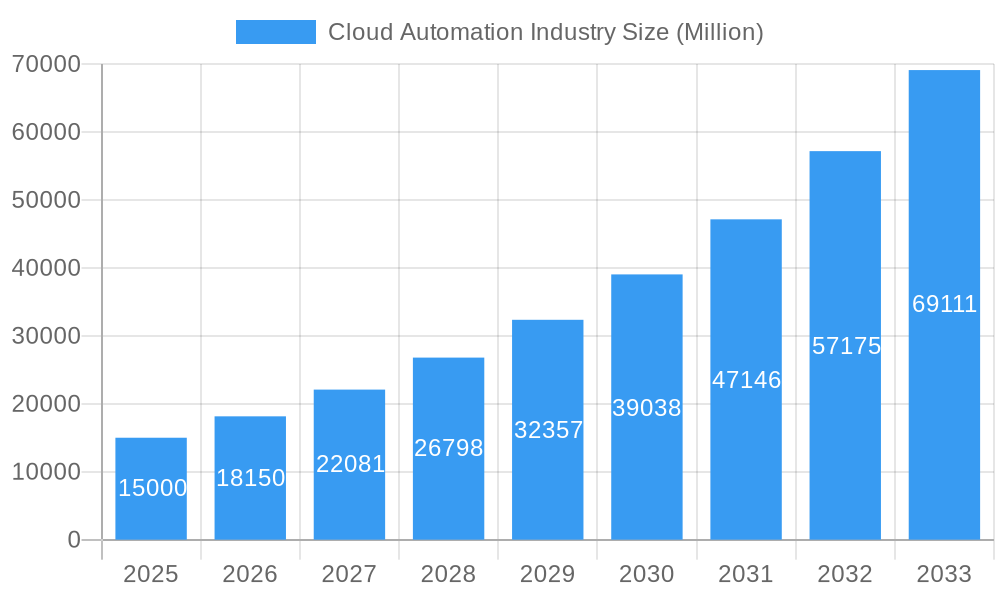
The cloud automation market is experiencing robust growth, projected to reach a substantial size driven by the increasing adoption of cloud computing across diverse industries. The market's Compound Annual Growth Rate (CAGR) of 21% from 2019 to 2024 indicates significant expansion, and this momentum is expected to continue through 2033. Key drivers include the need for enhanced operational efficiency, reduced IT costs, improved scalability and agility, and the rising demand for DevOps practices. Businesses are increasingly leveraging cloud automation solutions to streamline IT operations, accelerate application deployments, and optimize resource utilization. The market segmentation reveals a strong preference for hybrid cloud models, reflecting a practical approach to cloud adoption that balances the benefits of public and private cloud environments. Major players like Amazon, Microsoft, Google, and IBM are heavily invested in this space, fueling competition and innovation, leading to continuous advancements in automation technologies and capabilities. The geographic distribution shows strong market presence across North America, Europe, and Asia-Pacific, with emerging markets in other regions also exhibiting promising growth potential. The continued expansion of cloud infrastructure, coupled with increasing digital transformation initiatives, will further propel the growth of this sector in the years to come.
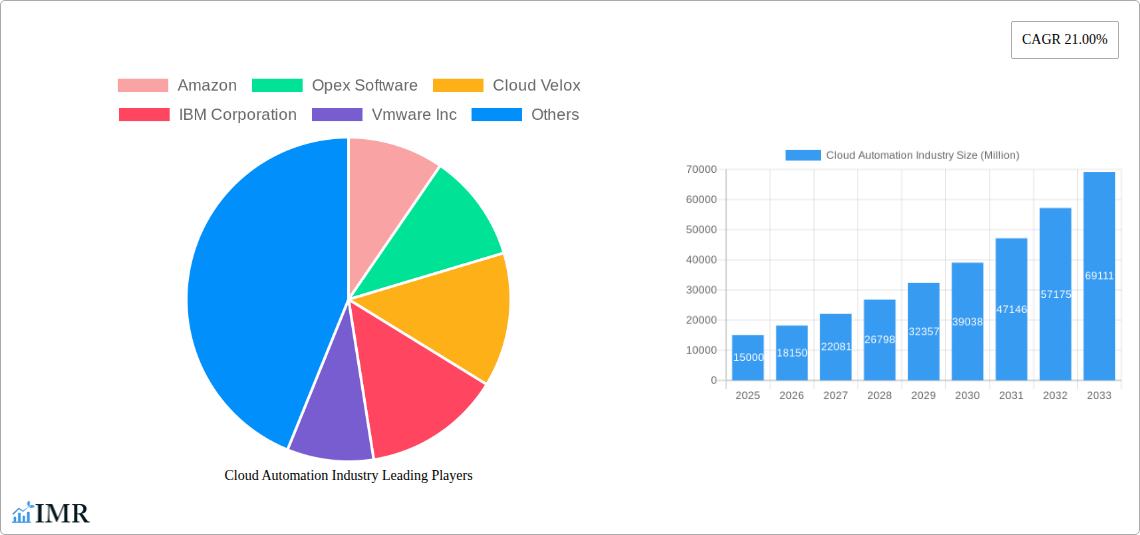
Cloud Automation Industry Market Size (In Billion)

The competitive landscape is characterized by a mix of established technology giants and specialized cloud automation vendors. This creates a dynamic environment with diverse offerings and pricing models catering to the varying needs of different organizations. While the market is expanding rapidly, challenges remain, including concerns regarding security, integration complexities, and the need for skilled personnel to manage and maintain these complex systems. However, ongoing investments in research and development, coupled with the development of user-friendly interfaces and automated management tools, are addressing these challenges and further driving market adoption. Regional variations in cloud adoption rates and digital maturity levels influence market penetration, resulting in differing growth trajectories across geographical regions. The continued focus on improving the security and scalability of cloud automation platforms will be crucial for sustained market growth and widespread industry adoption.
Cloud Automation Industry Company Market Share
Cloud Automation Industry Market Report: 2019-2033
This comprehensive report provides an in-depth analysis of the Cloud Automation industry, covering market dynamics, growth trends, regional segmentation, product landscape, key players, and future outlook. With a study period spanning 2019-2033, a base year of 2025, and a forecast period of 2025-2033, this report is an essential resource for industry professionals, investors, and strategists seeking to understand and capitalize on the opportunities within this rapidly evolving market. The report’s analysis considers both parent and child market segments, offering granular insights. The total market value in 2025 is estimated at XX Million.
Cloud Automation Industry Market Dynamics & Structure
The Cloud Automation market is characterized by a moderately concentrated structure, with major players like Amazon, Microsoft, and Google holding significant market share. However, the market is dynamic, with continuous technological innovation driving competition and market consolidation. Regulatory frameworks, particularly around data privacy and security, play a significant role in shaping market behavior. The emergence of alternative solutions, such as on-premises automation tools, presents competitive challenges, but cloud's inherent scalability and cost-effectiveness remain key advantages. End-user demographics are expanding rapidly, driven by the increasing adoption of cloud services across diverse industries. M&A activity has been significant, with a total of xx deals recorded in the historical period (2019-2024), reflecting consolidation trends and efforts to enhance technological capabilities.
- Market Concentration: High, with top 5 players holding approximately xx% market share in 2025.
- Innovation Drivers: AI/ML integration, serverless computing, automation-as-a-service (AaaS).
- Regulatory Frameworks: GDPR, CCPA, and other data privacy regulations influence vendor strategies.
- Competitive Substitutes: On-premise automation tools, but cloud's scalability remains a strong differentiator.
- M&A Trends: xx deals recorded from 2019-2024, focused on technology acquisition and market expansion.
- End-User Demographics: Rapidly expanding, driven by cloud adoption across various sectors (Finance, Healthcare, Manufacturing).
Cloud Automation Industry Growth Trends & Insights
The Cloud Automation market has experienced substantial growth over the historical period (2019-2024), fueled by the widespread adoption of cloud computing and the increasing demand for efficient IT infrastructure management. The market is projected to continue its growth trajectory, with a Compound Annual Growth Rate (CAGR) of xx% during the forecast period (2025-2033). This growth is driven by several factors, including the rising complexity of cloud environments, the need for improved operational efficiency, and the increasing adoption of DevOps and Agile methodologies. Technological advancements such as AI-powered automation tools are further accelerating market expansion. Consumer behavior shifts toward cloud-native applications and microservices architectures also significantly contribute to the market's growth. Market penetration is projected to reach xx% by 2033.
Dominant Regions, Countries, or Segments in Cloud Automation Industry
North America currently dominates the Cloud Automation market, driven by early adoption of cloud technologies and a well-established IT infrastructure. However, the Asia-Pacific region is expected to show the highest growth rate during the forecast period, fueled by rapid digital transformation initiatives and increasing investments in cloud infrastructure. Within market segmentation, the Hybrid Cloud segment holds the largest market share, followed by Public Cloud and Private Cloud. By end-user, the IT and Telecom sectors are the key drivers of market growth.
- Key Drivers in North America: Strong IT infrastructure, early adoption of cloud technologies, and high spending on IT.
- Key Drivers in Asia-Pacific: Rapid digital transformation, increasing investments in cloud infrastructure, and government support for cloud adoption.
- Hybrid Cloud Segment Dominance: Flexibility and scalability offered by hybrid cloud solutions meet diverse business needs.
- IT and Telecom Sector Leadership: High dependence on efficient IT infrastructure and extensive use of cloud services.
Cloud Automation Industry Product Landscape
The Cloud Automation product landscape is characterized by diverse solutions, including Infrastructure-as-Code (IaC) tools, configuration management platforms, container orchestration systems, and AI-powered automation tools. These products offer various features, including automated provisioning, deployment, scaling, and management of cloud resources. Unique selling propositions include enhanced security, simplified operations, and improved cost optimization. Technological advancements focus on AI/ML integration for intelligent automation, improved security features, and enhanced integration with DevOps tools.
Key Drivers, Barriers & Challenges in Cloud Automation Industry
Key Drivers:
- Increasing adoption of cloud computing services.
- The rising complexity of cloud environments, demanding efficient management tools.
- Growing demand for improved operational efficiency and cost optimization.
- The increasing adoption of DevOps and Agile methodologies.
Challenges & Restraints:
- Security concerns related to cloud automation tools.
- High initial investment costs associated with implementing cloud automation solutions.
- Skill shortage in managing and operating cloud automation tools.
- Integration challenges between existing IT infrastructure and cloud automation solutions.
Emerging Opportunities in Cloud Automation Industry
- Serverless Computing Automation: Automating the deployment and management of serverless functions.
- AI-driven Automation: Leveraging AI and ML for intelligent automation and predictive analytics.
- Edge Computing Automation: Extending automation capabilities to edge devices and IoT environments.
- Multi-cloud Management Automation: Simplifying management across multiple cloud platforms.
Growth Accelerators in the Cloud Automation Industry
Technological breakthroughs such as AI-powered automation and serverless computing are significantly accelerating growth. Strategic partnerships between cloud providers and automation vendors are expanding market reach and driving innovation. Market expansion into new regions, especially in developing economies, presents significant growth potential.
Key Players Shaping the Cloud Automation Industry Market
Notable Milestones in Cloud Automation Industry Sector
- December 2022: T-Mobile and Cisco launched the world's largest cloud-native 5G converged core gateway. This significantly advanced 5G network automation and scalability.
- September 2022: Kyndryl and Citrix partnered to accelerate digital workplace virtualization, enhancing hybrid and multi-cloud environment management.
In-Depth Cloud Automation Industry Market Outlook
The Cloud Automation market is poised for sustained growth, driven by ongoing digital transformation initiatives, increasing cloud adoption, and continuous technological innovation. Strategic partnerships, expansion into new markets, and the development of advanced automation technologies will further fuel market expansion. The long-term outlook remains positive, with significant opportunities for both established players and new entrants.
Cloud Automation Industry Segmentation
-
1. Type
- 1.1. Public Cloud
- 1.2. Private Cloud
- 1.3. Hybrid Cloud
-
2. End-user
- 2.1. BFSI
- 2.2. Healthcare
- 2.3. IT & Telecom
- 2.4. Manufacturing
- 2.5. Retail
- 2.6. Others
Cloud Automation Industry Segmentation By Geography
-
1. North America
- 1.1. Europe
- 1.2. Asia Pacific
- 1.3. Latin America
- 1.4. Middle East and Africa
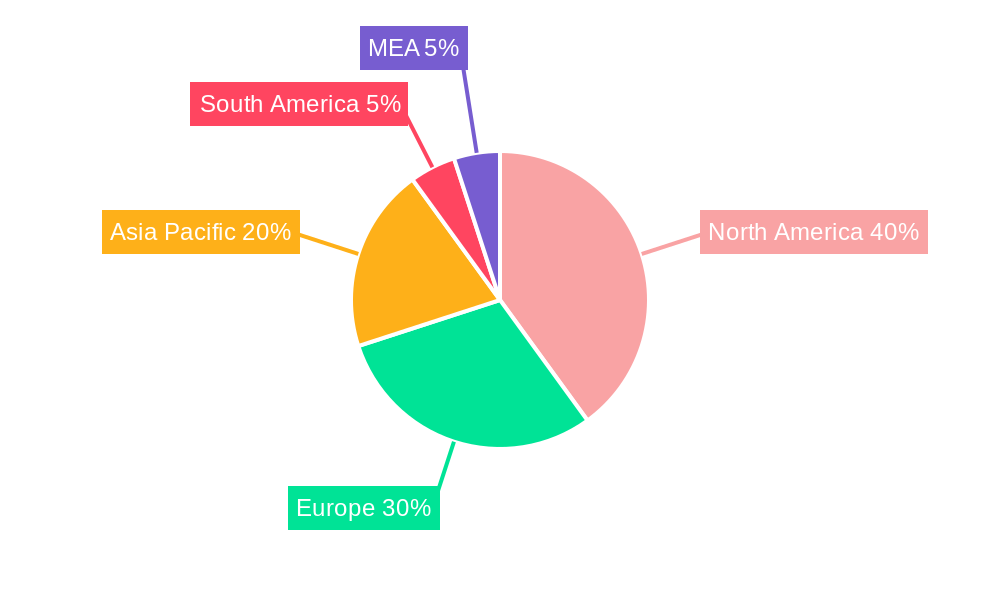
Cloud Automation Industry Regional Market Share
Geographic Coverage of Cloud Automation Industry
Cloud Automation Industry REPORT HIGHLIGHTS
| Aspects | Details |
|---|---|
| Study Period | 2020-2034 |
| Base Year | 2025 |
| Estimated Year | 2026 |
| Forecast Period | 2026-2034 |
| Historical Period | 2020-2025 |
| Growth Rate | CAGR of 21.00% from 2020-2034 |
| Segmentation |
|
Table of Contents
- 1. Introduction
- 1.1. Research Scope
- 1.2. Market Segmentation
- 1.3. Research Methodology
- 1.4. Definitions and Assumptions
- 2. Executive Summary
- 2.1. Introduction
- 3. Market Dynamics
- 3.1. Introduction
- 3.2. Market Drivers
- 3.2.1. Growing demand for low-cost storage and faster data accessibility; Rising investments in R&D and emerging automation solutions
- 3.3. Market Restrains
- 3.3.1. Privacy and security concerns
- 3.4. Market Trends
- 3.4.1. Hybrid Cloud is Expected to Hold a Significant Market Share
- 4. Market Factor Analysis
- 4.1. Porters Five Forces
- 4.2. Supply/Value Chain
- 4.3. PESTEL analysis
- 4.4. Market Entropy
- 4.5. Patent/Trademark Analysis
- 5. Global Cloud Automation Industry Analysis, Insights and Forecast, 2020-2032
- 5.1. Market Analysis, Insights and Forecast - by Type
- 5.1.1. Public Cloud
- 5.1.2. Private Cloud
- 5.1.3. Hybrid Cloud
- 5.2. Market Analysis, Insights and Forecast - by End-user
- 5.2.1. BFSI
- 5.2.2. Healthcare
- 5.2.3. IT & Telecom
- 5.2.4. Manufacturing
- 5.2.5. Retail
- 5.2.6. Others
- 5.3. Market Analysis, Insights and Forecast - by Region
- 5.3.1. North America
- 5.1. Market Analysis, Insights and Forecast - by Type
- 6. Competitive Analysis
- 6.1. Global Market Share Analysis 2025
- 6.2. Company Profiles
- 6.2.1 Amazon
- 6.2.1.1. Overview
- 6.2.1.2. Products
- 6.2.1.3. SWOT Analysis
- 6.2.1.4. Recent Developments
- 6.2.1.5. Financials (Based on Availability)
- 6.2.2 Opex Software
- 6.2.2.1. Overview
- 6.2.2.2. Products
- 6.2.2.3. SWOT Analysis
- 6.2.2.4. Recent Developments
- 6.2.2.5. Financials (Based on Availability)
- 6.2.3 Cloud Velox
- 6.2.3.1. Overview
- 6.2.3.2. Products
- 6.2.3.3. SWOT Analysis
- 6.2.3.4. Recent Developments
- 6.2.3.5. Financials (Based on Availability)
- 6.2.4 IBM Corporation
- 6.2.4.1. Overview
- 6.2.4.2. Products
- 6.2.4.3. SWOT Analysis
- 6.2.4.4. Recent Developments
- 6.2.4.5. Financials (Based on Availability)
- 6.2.5 Vmware Inc
- 6.2.5.1. Overview
- 6.2.5.2. Products
- 6.2.5.3. SWOT Analysis
- 6.2.5.4. Recent Developments
- 6.2.5.5. Financials (Based on Availability)
- 6.2.6 Cisco Systems Inc
- 6.2.6.1. Overview
- 6.2.6.2. Products
- 6.2.6.3. SWOT Analysis
- 6.2.6.4. Recent Developments
- 6.2.6.5. Financials (Based on Availability)
- 6.2.7 Hewlett Packard Enterprise (HPE)
- 6.2.7.1. Overview
- 6.2.7.2. Products
- 6.2.7.3. SWOT Analysis
- 6.2.7.4. Recent Developments
- 6.2.7.5. Financials (Based on Availability)
- 6.2.8 Google
- 6.2.8.1. Overview
- 6.2.8.2. Products
- 6.2.8.3. SWOT Analysis
- 6.2.8.4. Recent Developments
- 6.2.8.5. Financials (Based on Availability)
- 6.2.9 Microsoft Corporation
- 6.2.9.1. Overview
- 6.2.9.2. Products
- 6.2.9.3. SWOT Analysis
- 6.2.9.4. Recent Developments
- 6.2.9.5. Financials (Based on Availability)
- 6.2.10 Alibaba Cloud
- 6.2.10.1. Overview
- 6.2.10.2. Products
- 6.2.10.3. SWOT Analysis
- 6.2.10.4. Recent Developments
- 6.2.10.5. Financials (Based on Availability)
- 6.2.11 Oracle Corporation
- 6.2.11.1. Overview
- 6.2.11.2. Products
- 6.2.11.3. SWOT Analysis
- 6.2.11.4. Recent Developments
- 6.2.11.5. Financials (Based on Availability)
- 6.2.12 Citrix Systems Inc
- 6.2.12.1. Overview
- 6.2.12.2. Products
- 6.2.12.3. SWOT Analysis
- 6.2.12.4. Recent Developments
- 6.2.12.5. Financials (Based on Availability)
- 6.2.1 Amazon
List of Figures
- Figure 1: Global Cloud Automation Industry Revenue Breakdown (Million, %) by Region 2025 & 2033
- Figure 2: Global Cloud Automation Industry Volume Breakdown (K Unit, %) by Region 2025 & 2033
- Figure 3: North America Cloud Automation Industry Revenue (Million), by Type 2025 & 2033
- Figure 4: North America Cloud Automation Industry Volume (K Unit), by Type 2025 & 2033
- Figure 5: North America Cloud Automation Industry Revenue Share (%), by Type 2025 & 2033
- Figure 6: North America Cloud Automation Industry Volume Share (%), by Type 2025 & 2033
- Figure 7: North America Cloud Automation Industry Revenue (Million), by End-user 2025 & 2033
- Figure 8: North America Cloud Automation Industry Volume (K Unit), by End-user 2025 & 2033
- Figure 9: North America Cloud Automation Industry Revenue Share (%), by End-user 2025 & 2033
- Figure 10: North America Cloud Automation Industry Volume Share (%), by End-user 2025 & 2033
- Figure 11: North America Cloud Automation Industry Revenue (Million), by Country 2025 & 2033
- Figure 12: North America Cloud Automation Industry Volume (K Unit), by Country 2025 & 2033
- Figure 13: North America Cloud Automation Industry Revenue Share (%), by Country 2025 & 2033
- Figure 14: North America Cloud Automation Industry Volume Share (%), by Country 2025 & 2033
List of Tables
- Table 1: Global Cloud Automation Industry Revenue Million Forecast, by Type 2020 & 2033
- Table 2: Global Cloud Automation Industry Volume K Unit Forecast, by Type 2020 & 2033
- Table 3: Global Cloud Automation Industry Revenue Million Forecast, by End-user 2020 & 2033
- Table 4: Global Cloud Automation Industry Volume K Unit Forecast, by End-user 2020 & 2033
- Table 5: Global Cloud Automation Industry Revenue Million Forecast, by Region 2020 & 2033
- Table 6: Global Cloud Automation Industry Volume K Unit Forecast, by Region 2020 & 2033
- Table 7: Global Cloud Automation Industry Revenue Million Forecast, by Type 2020 & 2033
- Table 8: Global Cloud Automation Industry Volume K Unit Forecast, by Type 2020 & 2033
- Table 9: Global Cloud Automation Industry Revenue Million Forecast, by End-user 2020 & 2033
- Table 10: Global Cloud Automation Industry Volume K Unit Forecast, by End-user 2020 & 2033
- Table 11: Global Cloud Automation Industry Revenue Million Forecast, by Country 2020 & 2033
- Table 12: Global Cloud Automation Industry Volume K Unit Forecast, by Country 2020 & 2033
- Table 13: Europe Cloud Automation Industry Revenue (Million) Forecast, by Application 2020 & 2033
- Table 14: Europe Cloud Automation Industry Volume (K Unit) Forecast, by Application 2020 & 2033
- Table 15: Asia Pacific Cloud Automation Industry Revenue (Million) Forecast, by Application 2020 & 2033
- Table 16: Asia Pacific Cloud Automation Industry Volume (K Unit) Forecast, by Application 2020 & 2033
- Table 17: Latin America Cloud Automation Industry Revenue (Million) Forecast, by Application 2020 & 2033
- Table 18: Latin America Cloud Automation Industry Volume (K Unit) Forecast, by Application 2020 & 2033
- Table 19: Middle East and Africa Cloud Automation Industry Revenue (Million) Forecast, by Application 2020 & 2033
- Table 20: Middle East and Africa Cloud Automation Industry Volume (K Unit) Forecast, by Application 2020 & 2033
Frequently Asked Questions
1. What is the projected Compound Annual Growth Rate (CAGR) of the Cloud Automation Industry?
The projected CAGR is approximately 21.00%.
2. Which companies are prominent players in the Cloud Automation Industry?
Key companies in the market include Amazon, Opex Software, Cloud Velox, IBM Corporation, Vmware Inc, Cisco Systems Inc, Hewlett Packard Enterprise (HPE), Google, Microsoft Corporation, Alibaba Cloud , Oracle Corporation, Citrix Systems Inc.
3. What are the main segments of the Cloud Automation Industry?
The market segments include Type, End-user.
4. Can you provide details about the market size?
The market size is estimated to be USD XX Million as of 2022.
5. What are some drivers contributing to market growth?
Growing demand for low-cost storage and faster data accessibility; Rising investments in R&D and emerging automation solutions.
6. What are the notable trends driving market growth?
Hybrid Cloud is Expected to Hold a Significant Market Share.
7. Are there any restraints impacting market growth?
Privacy and security concerns.
8. Can you provide examples of recent developments in the market?
December 2022 - T-Mobile collaborated with Cisco to launch the world's largest highly scalable and distributed nationwide cloud native 5G converged core gateway.
9. What pricing options are available for accessing the report?
Pricing options include single-user, multi-user, and enterprise licenses priced at USD 4750, USD 5250, and USD 8750 respectively.
10. Is the market size provided in terms of value or volume?
The market size is provided in terms of value, measured in Million and volume, measured in K Unit.
11. Are there any specific market keywords associated with the report?
Yes, the market keyword associated with the report is "Cloud Automation Industry," which aids in identifying and referencing the specific market segment covered.
12. How do I determine which pricing option suits my needs best?
The pricing options vary based on user requirements and access needs. Individual users may opt for single-user licenses, while businesses requiring broader access may choose multi-user or enterprise licenses for cost-effective access to the report.
13. Are there any additional resources or data provided in the Cloud Automation Industry report?
While the report offers comprehensive insights, it's advisable to review the specific contents or supplementary materials provided to ascertain if additional resources or data are available.
14. How can I stay updated on further developments or reports in the Cloud Automation Industry?
To stay informed about further developments, trends, and reports in the Cloud Automation Industry, consider subscribing to industry newsletters, following relevant companies and organizations, or regularly checking reputable industry news sources and publications.
Methodology
Step 1 - Identification of Relevant Samples Size from Population Database



Step 2 - Approaches for Defining Global Market Size (Value, Volume* & Price*)

Note*: In applicable scenarios
Step 3 - Data Sources
Primary Research
- Web Analytics
- Survey Reports
- Research Institute
- Latest Research Reports
- Opinion Leaders
Secondary Research
- Annual Reports
- White Paper
- Latest Press Release
- Industry Association
- Paid Database
- Investor Presentations

Step 4 - Data Triangulation
Involves using different sources of information in order to increase the validity of a study
These sources are likely to be stakeholders in a program - participants, other researchers, program staff, other community members, and so on.
Then we put all data in single framework & apply various statistical tools to find out the dynamic on the market.
During the analysis stage, feedback from the stakeholder groups would be compared to determine areas of agreement as well as areas of divergence