


Key Insights
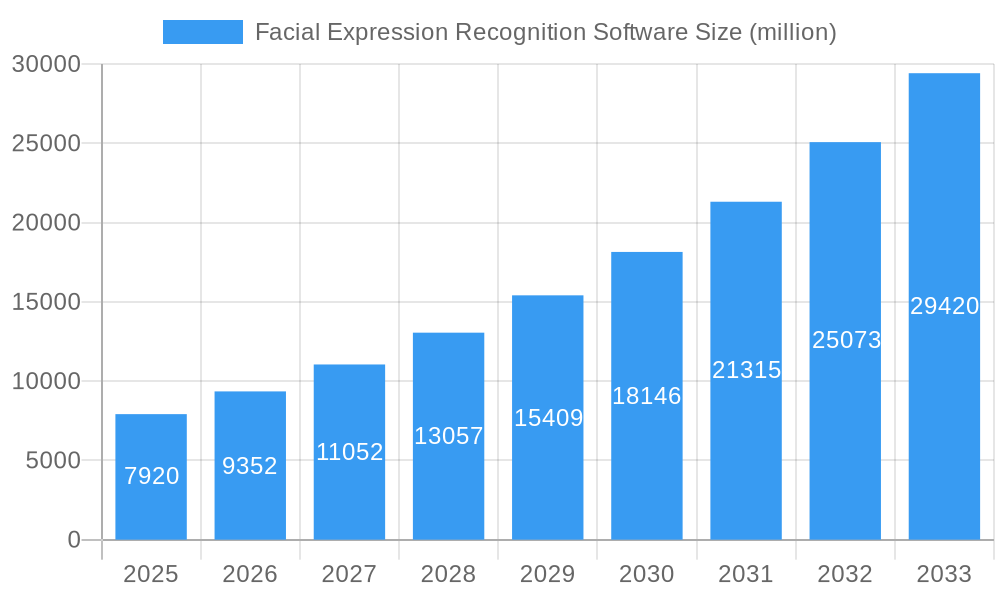
The global market for Facial Expression Recognition (FER) software is poised for remarkable expansion, driven by its burgeoning applications across diverse sectors. Anticipated to reach USD 7.92 billion in 2025, the market is projected to witness a robust Compound Annual Growth Rate (CAGR) of 17.9% during the forecast period of 2025-2033. This significant growth is fueled by increasing investments in artificial intelligence and machine learning, coupled with the escalating demand for enhanced customer experiences and personalized interactions. The Games and Entertainment sector is a primary beneficiary, leveraging FER for more immersive gaming and personalized content delivery. Similarly, Psychological Research is benefiting from advanced analytical capabilities, allowing for deeper insights into human emotions and behavior. The Product Sales segment is also witnessing a surge, with FER enabling sentiment analysis for marketing campaigns and product development. While the initial market adoption was driven by cloud-based solutions due to their scalability and accessibility, on-premises deployments are gaining traction, particularly for organizations with stringent data privacy requirements. The integration of FER into various devices and platforms is expected to further accelerate market penetration.
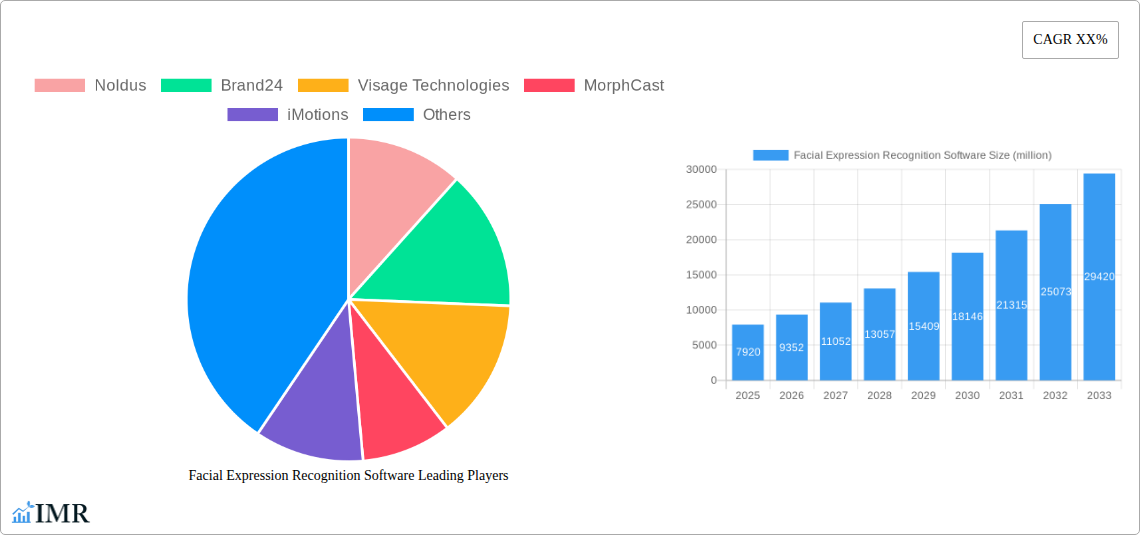
Facial Expression Recognition Software Market Size (In Billion)

The market's trajectory is further shaped by key trends such as the development of real-time emotion detection, the integration of multimodal emotion recognition (combining facial expressions with voice and body language), and the increasing adoption of FER in the automotive industry for driver monitoring and safety. The potential for FER in mental health monitoring and diagnostic tools is also a significant emerging trend. However, the market is not without its challenges. Concerns regarding data privacy and ethical implications, alongside the need for highly accurate and unbiased algorithms across diverse demographics, represent key restraints. Sophisticated AI models are continuously being developed to mitigate these concerns. Major players like Noldus, Brand24, Visage Technologies, iMotions, and Affectiva are at the forefront of innovation, continuously introducing advanced FER solutions. The market's global reach is evident, with North America and Europe leading in adoption, while the Asia Pacific region is expected to exhibit the fastest growth due to rapid technological advancements and increasing per capita income.
Facial Expression Recognition Software Company Market Share
Here is the SEO-optimized report description for Facial Expression Recognition Software:
Facial Expression Recognition Software Market Dynamics & Structure
The global Facial Expression Recognition Software market is characterized by a dynamic interplay of technological advancements, evolving end-user demands, and a competitive landscape. Market concentration is currently moderate, with key players such as Noldus, Affectiva, Megvii, and Kairos vying for market share. Technological innovation is a primary driver, fueled by advancements in artificial intelligence (AI), machine learning (ML), and computer vision. These innovations are leading to more accurate and nuanced emotion detection, expanding the software's applicability across various sectors. Regulatory frameworks, while still developing in some regions, are increasingly focused on data privacy and ethical AI deployment, influencing development and adoption strategies. Competitive product substitutes, though not direct replacements, include traditional market research methods and sentiment analysis tools. End-user demographics are diversifying, with increasing adoption by gaming companies, psychological researchers, and product developers seeking deeper consumer insights. Mergers and Acquisitions (M&A) trends are active, as larger technology firms and established market research companies seek to integrate advanced facial expression recognition capabilities into their offerings. Recent M&A activities, estimated at XX billion USD in deal volume over the historical period, indicate a consolidation phase and a strong drive for acquiring specialized technology and talent. Innovation barriers, such as the need for extensive and diverse training data sets and the ethical considerations surrounding emotion recognition, remain significant. The market is projected to witness substantial growth, driven by the increasing demand for emotionally intelligent applications and services.
- Market Concentration: Moderate, with a few dominant players and a growing number of niche providers.
- Technological Innovation Drivers: AI, ML, deep learning, computer vision, real-time processing, and emotion intensity scoring.
- Regulatory Frameworks: Growing focus on data privacy (e.g., GDPR, CCPA) and AI ethics.
- Competitive Product Substitutes: Traditional surveys, focus groups, general sentiment analysis tools.
- End-User Demographics: Expanding beyond research to include gaming, marketing, healthcare, automotive, and HR sectors.
- M&A Trends: Active consolidation, strategic acquisitions of startups with specialized AI/ML capabilities.
- Estimated M&A Deal Volume (Historical Period): XX billion USD.
Facial Expression Recognition Software Growth Trends & Insights
The global Facial Expression Recognition Software market is poised for robust expansion, driven by a confluence of technological breakthroughs and widening application horizons. The market size, valued at an estimated XX billion USD in the base year of 2025, is projected to ascend significantly through the forecast period, reaching an estimated XX billion USD by 2033, exhibiting a Compound Annual Growth Rate (CAGR) of XX%. This impressive growth trajectory is underpinned by escalating adoption rates across diverse industries seeking to leverage human emotional responses for enhanced user experiences, product development, and market understanding. Technological disruptions, particularly in the realm of deep learning algorithms and the increasing accuracy of emotion detection, are paving the way for more sophisticated and reliable facial expression analysis. These advancements are enabling real-time emotion recognition, distinguishing subtle micro-expressions, and providing granular insights into user sentiment, which were previously unattainable.
Consumer behavior shifts are also playing a pivotal role. As digital interactions become more prevalent, the demand for emotionally intelligent systems that can adapt and respond to human emotions is surging. This is evident in the gaming industry, where developers are integrating facial expression recognition to create more immersive and personalized gameplay. In psychological research, the software is revolutionizing the study of human emotions, offering objective and quantifiable data for analysis. The product sales segment is witnessing a surge in demand for facial expression analysis to gauge customer reactions to marketing campaigns, product prototypes, and in-store experiences, leading to improved product design and marketing strategies. Furthermore, the 'Others' segment, encompassing applications in areas like healthcare for patient monitoring and in the automotive sector for driver safety, is rapidly emerging as a significant growth driver. The penetration of cloud-based solutions continues to outpace on-premises deployments due to their scalability, flexibility, and reduced upfront costs, making advanced facial expression recognition technology accessible to a broader range of businesses. The historical period from 2019 to 2024 saw foundational growth, with market participants establishing core technologies and initial use cases. The base year of 2025 marks a pivotal point where broader market acceptance and significant investment are expected to accelerate these adoption rates further.
Dominant Regions, Countries, or Segments in Facial Expression Recognition Software
The global Facial Expression Recognition Software market’s expansion is being significantly influenced by key regions and segments, with North America currently holding a dominant position, driven by robust technological innovation, substantial investment in AI research and development, and a high concentration of early adopters across various industries. The United States, in particular, is a powerhouse, fueled by leading technology companies like Affectiva and iMotions, which are at the forefront of developing and deploying advanced facial expression recognition solutions. This dominance is further bolstered by strong venture capital funding for AI startups and a supportive ecosystem for technological advancements.
Within the Application segments, Games and Entertainment is emerging as a particularly strong growth engine. The increasing demand for immersive and interactive gaming experiences, where players’ emotional responses can directly influence gameplay, is driving significant adoption of facial expression recognition technology. Companies are leveraging this technology to personalize gaming narratives, enhance character interactions, and create more engaging virtual environments. Following closely is Product Sales, where retailers and marketers are utilizing facial expression analysis to understand consumer reactions to products, advertisements, and store layouts, leading to optimized marketing campaigns and improved customer satisfaction. Psychological Research continues to be a foundational segment, providing critical data for understanding human emotions and behavior, with advancements in software enabling more objective and quantitative analysis.
In terms of Types, Cloud Based solutions are experiencing accelerated growth and widespread adoption. The inherent scalability, cost-effectiveness, and accessibility of cloud platforms allow businesses of all sizes to leverage sophisticated facial expression recognition capabilities without significant upfront infrastructure investment. This has democratized access to advanced analytics, enabling a wider range of applications and fostering innovation. The On-Premises segment, while still relevant for organizations with stringent data security and privacy requirements, is seeing a slower growth rate compared to its cloud-based counterpart.
- Dominant Region: North America, particularly the United States.
- Key Drivers in North America: High AI investment, strong R&D infrastructure, early adopter market, presence of leading technology companies.
- Leading Application Segment: Games and Entertainment, followed by Product Sales.
- Drivers for Games and Entertainment: Demand for immersive experiences, personalized gameplay, interactive narratives.
- Drivers for Product Sales: Consumer reaction analysis for marketing optimization, product development insights, enhanced customer engagement.
- Dominant Software Type: Cloud Based.
- Drivers for Cloud Based Solutions: Scalability, cost-efficiency, accessibility, rapid deployment, ease of integration.
Facial Expression Recognition Software Product Landscape
The product landscape of facial expression recognition software is characterized by rapid innovation, focusing on enhanced accuracy, real-time processing, and broader emotion detection capabilities. Leading solutions from companies like Affectiva, Megvii, and Kairos are increasingly capable of identifying a wider spectrum of emotions, including subtle micro-expressions and complex emotional states. These products often integrate advanced AI and deep learning algorithms to achieve high precision, offering performance metrics such as XX% accuracy in emotion detection. Unique selling propositions include the ability to perform analysis on diverse demographic groups, adapt to varying lighting conditions, and provide actionable insights through intuitive dashboards. Technological advancements are enabling real-time video analysis for immediate feedback, crucial for applications in gaming, advertising, and user experience testing.
Key Drivers, Barriers & Challenges in Facial Expression Recognition Software
Key Drivers: The facial expression recognition software market is primarily propelled by the relentless pursuit of enhanced customer understanding and personalized user experiences across industries. Technological advancements in AI, machine learning, and computer vision are continuously improving the accuracy and granularity of emotion detection. The increasing adoption of smart devices and IoT ecosystems provides a fertile ground for integrated emotion-aware applications. Furthermore, the growing demand for objective sentiment analysis in market research, product development, and human-computer interaction is a significant growth accelerator. Government initiatives promoting AI adoption and digital transformation also play a crucial role in fostering market expansion.
- Technological Advancements: AI, ML, deep learning, computer vision accuracy improvements.
- Demand for Personalization: Enhanced customer experience in gaming, marketing, and entertainment.
- Market Research Needs: Objective sentiment analysis and consumer feedback.
- Human-Computer Interaction (HCI): Development of more intuitive and empathetic interfaces.
- Government Support: Initiatives promoting AI and digital transformation.
Barriers & Challenges: Despite its promising growth, the market faces several hurdles. The ethical implications and potential for misuse of facial recognition technology, particularly concerning privacy concerns, pose significant regulatory and societal challenges. The need for large, diverse, and accurately labeled datasets for training AI models remains a complex and resource-intensive endeavor. Furthermore, the inherent subjectivity of human emotions and cultural variations in expression can impact the accuracy and universality of recognition. Intense competition from established tech giants and emerging startups can also create pricing pressures and necessitate continuous innovation. Supply chain issues are less pronounced for software compared to hardware, but access to specialized AI talent can be a bottleneck.
- Ethical Concerns & Privacy: Potential for misuse, public perception, and regulatory scrutiny.
- Data Requirements: Need for large, diverse, and unbiased training datasets.
- Subjectivity & Cultural Variance: Nuances in human emotions and expression interpretation.
- Intense Competition: Market saturation and pricing pressures.
- Talent Acquisition: Scarcity of skilled AI and ML engineers.
Emerging Opportunities in Facial Expression Recognition Software
The future of facial expression recognition software presents a wealth of untapped opportunities. The healthcare sector is a burgeoning area, with applications in mental health diagnostics, patient monitoring for pain or distress, and early detection of neurological disorders. The automotive industry is exploring its use for driver monitoring systems to detect fatigue or distraction, thereby enhancing road safety. The retail sector can leverage this technology for personalized in-store experiences and frictionless checkout processes. Furthermore, the development of 'emotionally intelligent' AI assistants and robots for elder care, education, and customer service represents a significant frontier. The integration of facial expression recognition with other biometric data, such as voice and physiological signals, will unlock more comprehensive and nuanced human-computer interaction.
Growth Accelerators in the Facial Expression Recognition Software Industry
Several key factors are acting as significant growth accelerators for the facial expression recognition software industry. The continuous evolution of AI and deep learning algorithms is leading to unprecedented levels of accuracy and sophistication in emotion detection. Strategic partnerships between software providers and hardware manufacturers are facilitating the seamless integration of facial recognition capabilities into a wider array of devices, from smartphones and smart mirrors to vehicles and wearables. Market expansion into developing economies, driven by increasing digital penetration and the growing need for advanced analytics, is opening up new revenue streams. Moreover, the burgeoning demand for emotionally responsive virtual assistants and augmented reality applications is creating novel use cases and driving further investment in research and development.
Key Players Shaping the Facial Expression Recognition Software Market
- Noldus
- Brand24
- Visage Technologies
- MorphCast
- iMotions
- Oxagile
- Affectiva
- SkyBiometry
- Megvii
- Kairos
- Luxand
- EyeSee
- Kingfar
Notable Milestones in Facial Expression Recognition Software Sector
- 2019: Advancements in deep learning frameworks lead to significant improvements in emotion classification accuracy.
- 2020: Increased adoption in remote work tools for sentiment analysis and engagement monitoring.
- 2021: Major tech companies invest heavily in R&D for emotionally intelligent AI, including facial expression recognition.
- 2022: Growing concerns around data privacy and AI ethics lead to increased regulatory discussions and framework development.
- 2023: Expansion of applications into healthcare for mental wellness monitoring and patient care.
- 2024: Introduction of more nuanced emotion detection capabilities, including micro-expression analysis.
In-Depth Facial Expression Recognition Software Market Outlook
The outlook for the facial expression recognition software market is exceptionally bright, driven by sustained technological innovation and an ever-expanding range of applications. Growth accelerators such as enhanced AI algorithms, strategic cross-industry partnerships, and the increasing demand for personalized digital experiences are poised to propel the market forward. Emerging opportunities in healthcare, automotive safety, and advanced robotics present substantial avenues for future growth. The shift towards cloud-based solutions will continue to democratize access to this transformative technology, enabling wider adoption and fostering continuous innovation. Companies that can effectively navigate ethical considerations while delivering accurate and insightful emotion recognition solutions will be best positioned for long-term success in this dynamic and rapidly evolving market.
Facial Expression Recognition Software Segmentation
-
1. Application
- 1.1. Games and Entertainment
- 1.2. Psychological Research
- 1.3. Product Sales
- 1.4. Others
-
2. Types
- 2.1. Cloud Based
- 2.2. On-Premises
Facial Expression Recognition Software Segmentation By Geography
-
1. North America
- 1.1. United States
- 1.2. Canada
- 1.3. Mexico
-
2. South America
- 2.1. Brazil
- 2.2. Argentina
- 2.3. Rest of South America
-
3. Europe
- 3.1. United Kingdom
- 3.2. Germany
- 3.3. France
- 3.4. Italy
- 3.5. Spain
- 3.6. Russia
- 3.7. Benelux
- 3.8. Nordics
- 3.9. Rest of Europe
-
4. Middle East & Africa
- 4.1. Turkey
- 4.2. Israel
- 4.3. GCC
- 4.4. North Africa
- 4.5. South Africa
- 4.6. Rest of Middle East & Africa
-
5. Asia Pacific
- 5.1. China
- 5.2. India
- 5.3. Japan
- 5.4. South Korea
- 5.5. ASEAN
- 5.6. Oceania
- 5.7. Rest of Asia Pacific
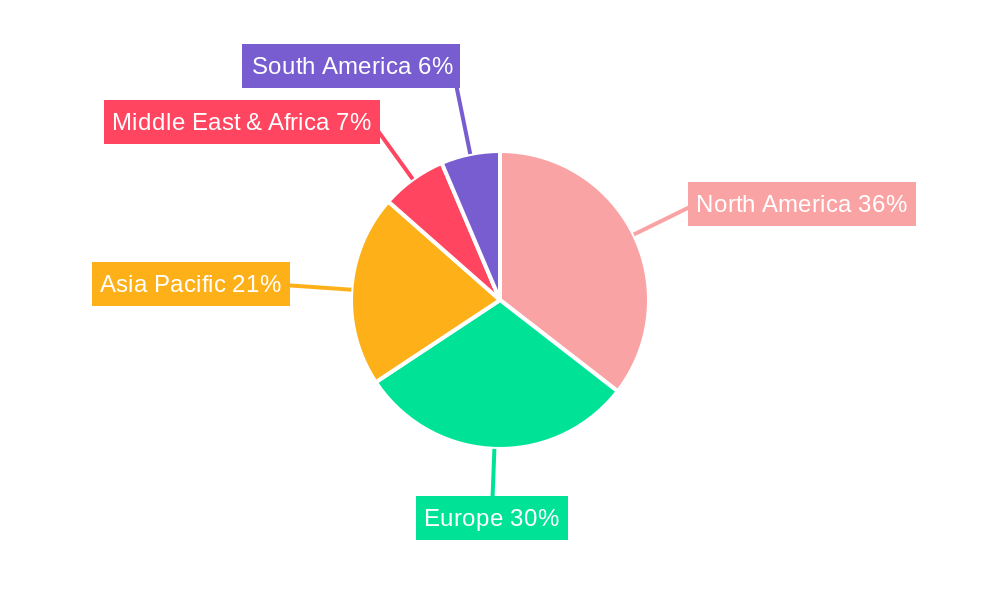
Facial Expression Recognition Software Regional Market Share
Geographic Coverage of Facial Expression Recognition Software
Facial Expression Recognition Software REPORT HIGHLIGHTS
| Aspects | Details |
|---|---|
| Study Period | 2020-2034 |
| Base Year | 2025 |
| Estimated Year | 2026 |
| Forecast Period | 2026-2034 |
| Historical Period | 2020-2025 |
| Growth Rate | CAGR of 17.9% from 2020-2034 |
| Segmentation |
|
Table of Contents
- 1. Introduction
- 1.1. Research Scope
- 1.2. Market Segmentation
- 1.3. Research Methodology
- 1.4. Definitions and Assumptions
- 2. Executive Summary
- 2.1. Introduction
- 3. Market Dynamics
- 3.1. Introduction
- 3.2. Market Drivers
- 3.3. Market Restrains
- 3.4. Market Trends
- 4. Market Factor Analysis
- 4.1. Porters Five Forces
- 4.2. Supply/Value Chain
- 4.3. PESTEL analysis
- 4.4. Market Entropy
- 4.5. Patent/Trademark Analysis
- 5. Global Facial Expression Recognition Software Analysis, Insights and Forecast, 2020-2032
- 5.1. Market Analysis, Insights and Forecast - by Application
- 5.1.1. Games and Entertainment
- 5.1.2. Psychological Research
- 5.1.3. Product Sales
- 5.1.4. Others
- 5.2. Market Analysis, Insights and Forecast - by Types
- 5.2.1. Cloud Based
- 5.2.2. On-Premises
- 5.3. Market Analysis, Insights and Forecast - by Region
- 5.3.1. North America
- 5.3.2. South America
- 5.3.3. Europe
- 5.3.4. Middle East & Africa
- 5.3.5. Asia Pacific
- 5.1. Market Analysis, Insights and Forecast - by Application
- 6. North America Facial Expression Recognition Software Analysis, Insights and Forecast, 2020-2032
- 6.1. Market Analysis, Insights and Forecast - by Application
- 6.1.1. Games and Entertainment
- 6.1.2. Psychological Research
- 6.1.3. Product Sales
- 6.1.4. Others
- 6.2. Market Analysis, Insights and Forecast - by Types
- 6.2.1. Cloud Based
- 6.2.2. On-Premises
- 6.1. Market Analysis, Insights and Forecast - by Application
- 7. South America Facial Expression Recognition Software Analysis, Insights and Forecast, 2020-2032
- 7.1. Market Analysis, Insights and Forecast - by Application
- 7.1.1. Games and Entertainment
- 7.1.2. Psychological Research
- 7.1.3. Product Sales
- 7.1.4. Others
- 7.2. Market Analysis, Insights and Forecast - by Types
- 7.2.1. Cloud Based
- 7.2.2. On-Premises
- 7.1. Market Analysis, Insights and Forecast - by Application
- 8. Europe Facial Expression Recognition Software Analysis, Insights and Forecast, 2020-2032
- 8.1. Market Analysis, Insights and Forecast - by Application
- 8.1.1. Games and Entertainment
- 8.1.2. Psychological Research
- 8.1.3. Product Sales
- 8.1.4. Others
- 8.2. Market Analysis, Insights and Forecast - by Types
- 8.2.1. Cloud Based
- 8.2.2. On-Premises
- 8.1. Market Analysis, Insights and Forecast - by Application
- 9. Middle East & Africa Facial Expression Recognition Software Analysis, Insights and Forecast, 2020-2032
- 9.1. Market Analysis, Insights and Forecast - by Application
- 9.1.1. Games and Entertainment
- 9.1.2. Psychological Research
- 9.1.3. Product Sales
- 9.1.4. Others
- 9.2. Market Analysis, Insights and Forecast - by Types
- 9.2.1. Cloud Based
- 9.2.2. On-Premises
- 9.1. Market Analysis, Insights and Forecast - by Application
- 10. Asia Pacific Facial Expression Recognition Software Analysis, Insights and Forecast, 2020-2032
- 10.1. Market Analysis, Insights and Forecast - by Application
- 10.1.1. Games and Entertainment
- 10.1.2. Psychological Research
- 10.1.3. Product Sales
- 10.1.4. Others
- 10.2. Market Analysis, Insights and Forecast - by Types
- 10.2.1. Cloud Based
- 10.2.2. On-Premises
- 10.1. Market Analysis, Insights and Forecast - by Application
- 11. Competitive Analysis
- 11.1. Global Market Share Analysis 2025
- 11.2. Company Profiles
- 11.2.1 Noldus
- 11.2.1.1. Overview
- 11.2.1.2. Products
- 11.2.1.3. SWOT Analysis
- 11.2.1.4. Recent Developments
- 11.2.1.5. Financials (Based on Availability)
- 11.2.2 Brand24
- 11.2.2.1. Overview
- 11.2.2.2. Products
- 11.2.2.3. SWOT Analysis
- 11.2.2.4. Recent Developments
- 11.2.2.5. Financials (Based on Availability)
- 11.2.3 Visage Technologies
- 11.2.3.1. Overview
- 11.2.3.2. Products
- 11.2.3.3. SWOT Analysis
- 11.2.3.4. Recent Developments
- 11.2.3.5. Financials (Based on Availability)
- 11.2.4 MorphCast
- 11.2.4.1. Overview
- 11.2.4.2. Products
- 11.2.4.3. SWOT Analysis
- 11.2.4.4. Recent Developments
- 11.2.4.5. Financials (Based on Availability)
- 11.2.5 iMotions
- 11.2.5.1. Overview
- 11.2.5.2. Products
- 11.2.5.3. SWOT Analysis
- 11.2.5.4. Recent Developments
- 11.2.5.5. Financials (Based on Availability)
- 11.2.6 Oxagile
- 11.2.6.1. Overview
- 11.2.6.2. Products
- 11.2.6.3. SWOT Analysis
- 11.2.6.4. Recent Developments
- 11.2.6.5. Financials (Based on Availability)
- 11.2.7 Affectiva
- 11.2.7.1. Overview
- 11.2.7.2. Products
- 11.2.7.3. SWOT Analysis
- 11.2.7.4. Recent Developments
- 11.2.7.5. Financials (Based on Availability)
- 11.2.8 SkyBiometry
- 11.2.8.1. Overview
- 11.2.8.2. Products
- 11.2.8.3. SWOT Analysis
- 11.2.8.4. Recent Developments
- 11.2.8.5. Financials (Based on Availability)
- 11.2.9 Megvii
- 11.2.9.1. Overview
- 11.2.9.2. Products
- 11.2.9.3. SWOT Analysis
- 11.2.9.4. Recent Developments
- 11.2.9.5. Financials (Based on Availability)
- 11.2.10 Kairos
- 11.2.10.1. Overview
- 11.2.10.2. Products
- 11.2.10.3. SWOT Analysis
- 11.2.10.4. Recent Developments
- 11.2.10.5. Financials (Based on Availability)
- 11.2.11 Luxand
- 11.2.11.1. Overview
- 11.2.11.2. Products
- 11.2.11.3. SWOT Analysis
- 11.2.11.4. Recent Developments
- 11.2.11.5. Financials (Based on Availability)
- 11.2.12 EyeSee
- 11.2.12.1. Overview
- 11.2.12.2. Products
- 11.2.12.3. SWOT Analysis
- 11.2.12.4. Recent Developments
- 11.2.12.5. Financials (Based on Availability)
- 11.2.13 Kingfar
- 11.2.13.1. Overview
- 11.2.13.2. Products
- 11.2.13.3. SWOT Analysis
- 11.2.13.4. Recent Developments
- 11.2.13.5. Financials (Based on Availability)
- 11.2.1 Noldus
List of Figures
- Figure 1: Global Facial Expression Recognition Software Revenue Breakdown (undefined, %) by Region 2025 & 2033
- Figure 2: North America Facial Expression Recognition Software Revenue (undefined), by Application 2025 & 2033
- Figure 3: North America Facial Expression Recognition Software Revenue Share (%), by Application 2025 & 2033
- Figure 4: North America Facial Expression Recognition Software Revenue (undefined), by Types 2025 & 2033
- Figure 5: North America Facial Expression Recognition Software Revenue Share (%), by Types 2025 & 2033
- Figure 6: North America Facial Expression Recognition Software Revenue (undefined), by Country 2025 & 2033
- Figure 7: North America Facial Expression Recognition Software Revenue Share (%), by Country 2025 & 2033
- Figure 8: South America Facial Expression Recognition Software Revenue (undefined), by Application 2025 & 2033
- Figure 9: South America Facial Expression Recognition Software Revenue Share (%), by Application 2025 & 2033
- Figure 10: South America Facial Expression Recognition Software Revenue (undefined), by Types 2025 & 2033
- Figure 11: South America Facial Expression Recognition Software Revenue Share (%), by Types 2025 & 2033
- Figure 12: South America Facial Expression Recognition Software Revenue (undefined), by Country 2025 & 2033
- Figure 13: South America Facial Expression Recognition Software Revenue Share (%), by Country 2025 & 2033
- Figure 14: Europe Facial Expression Recognition Software Revenue (undefined), by Application 2025 & 2033
- Figure 15: Europe Facial Expression Recognition Software Revenue Share (%), by Application 2025 & 2033
- Figure 16: Europe Facial Expression Recognition Software Revenue (undefined), by Types 2025 & 2033
- Figure 17: Europe Facial Expression Recognition Software Revenue Share (%), by Types 2025 & 2033
- Figure 18: Europe Facial Expression Recognition Software Revenue (undefined), by Country 2025 & 2033
- Figure 19: Europe Facial Expression Recognition Software Revenue Share (%), by Country 2025 & 2033
- Figure 20: Middle East & Africa Facial Expression Recognition Software Revenue (undefined), by Application 2025 & 2033
- Figure 21: Middle East & Africa Facial Expression Recognition Software Revenue Share (%), by Application 2025 & 2033
- Figure 22: Middle East & Africa Facial Expression Recognition Software Revenue (undefined), by Types 2025 & 2033
- Figure 23: Middle East & Africa Facial Expression Recognition Software Revenue Share (%), by Types 2025 & 2033
- Figure 24: Middle East & Africa Facial Expression Recognition Software Revenue (undefined), by Country 2025 & 2033
- Figure 25: Middle East & Africa Facial Expression Recognition Software Revenue Share (%), by Country 2025 & 2033
- Figure 26: Asia Pacific Facial Expression Recognition Software Revenue (undefined), by Application 2025 & 2033
- Figure 27: Asia Pacific Facial Expression Recognition Software Revenue Share (%), by Application 2025 & 2033
- Figure 28: Asia Pacific Facial Expression Recognition Software Revenue (undefined), by Types 2025 & 2033
- Figure 29: Asia Pacific Facial Expression Recognition Software Revenue Share (%), by Types 2025 & 2033
- Figure 30: Asia Pacific Facial Expression Recognition Software Revenue (undefined), by Country 2025 & 2033
- Figure 31: Asia Pacific Facial Expression Recognition Software Revenue Share (%), by Country 2025 & 2033
List of Tables
- Table 1: Global Facial Expression Recognition Software Revenue undefined Forecast, by Application 2020 & 2033
- Table 2: Global Facial Expression Recognition Software Revenue undefined Forecast, by Types 2020 & 2033
- Table 3: Global Facial Expression Recognition Software Revenue undefined Forecast, by Region 2020 & 2033
- Table 4: Global Facial Expression Recognition Software Revenue undefined Forecast, by Application 2020 & 2033
- Table 5: Global Facial Expression Recognition Software Revenue undefined Forecast, by Types 2020 & 2033
- Table 6: Global Facial Expression Recognition Software Revenue undefined Forecast, by Country 2020 & 2033
- Table 7: United States Facial Expression Recognition Software Revenue (undefined) Forecast, by Application 2020 & 2033
- Table 8: Canada Facial Expression Recognition Software Revenue (undefined) Forecast, by Application 2020 & 2033
- Table 9: Mexico Facial Expression Recognition Software Revenue (undefined) Forecast, by Application 2020 & 2033
- Table 10: Global Facial Expression Recognition Software Revenue undefined Forecast, by Application 2020 & 2033
- Table 11: Global Facial Expression Recognition Software Revenue undefined Forecast, by Types 2020 & 2033
- Table 12: Global Facial Expression Recognition Software Revenue undefined Forecast, by Country 2020 & 2033
- Table 13: Brazil Facial Expression Recognition Software Revenue (undefined) Forecast, by Application 2020 & 2033
- Table 14: Argentina Facial Expression Recognition Software Revenue (undefined) Forecast, by Application 2020 & 2033
- Table 15: Rest of South America Facial Expression Recognition Software Revenue (undefined) Forecast, by Application 2020 & 2033
- Table 16: Global Facial Expression Recognition Software Revenue undefined Forecast, by Application 2020 & 2033
- Table 17: Global Facial Expression Recognition Software Revenue undefined Forecast, by Types 2020 & 2033
- Table 18: Global Facial Expression Recognition Software Revenue undefined Forecast, by Country 2020 & 2033
- Table 19: United Kingdom Facial Expression Recognition Software Revenue (undefined) Forecast, by Application 2020 & 2033
- Table 20: Germany Facial Expression Recognition Software Revenue (undefined) Forecast, by Application 2020 & 2033
- Table 21: France Facial Expression Recognition Software Revenue (undefined) Forecast, by Application 2020 & 2033
- Table 22: Italy Facial Expression Recognition Software Revenue (undefined) Forecast, by Application 2020 & 2033
- Table 23: Spain Facial Expression Recognition Software Revenue (undefined) Forecast, by Application 2020 & 2033
- Table 24: Russia Facial Expression Recognition Software Revenue (undefined) Forecast, by Application 2020 & 2033
- Table 25: Benelux Facial Expression Recognition Software Revenue (undefined) Forecast, by Application 2020 & 2033
- Table 26: Nordics Facial Expression Recognition Software Revenue (undefined) Forecast, by Application 2020 & 2033
- Table 27: Rest of Europe Facial Expression Recognition Software Revenue (undefined) Forecast, by Application 2020 & 2033
- Table 28: Global Facial Expression Recognition Software Revenue undefined Forecast, by Application 2020 & 2033
- Table 29: Global Facial Expression Recognition Software Revenue undefined Forecast, by Types 2020 & 2033
- Table 30: Global Facial Expression Recognition Software Revenue undefined Forecast, by Country 2020 & 2033
- Table 31: Turkey Facial Expression Recognition Software Revenue (undefined) Forecast, by Application 2020 & 2033
- Table 32: Israel Facial Expression Recognition Software Revenue (undefined) Forecast, by Application 2020 & 2033
- Table 33: GCC Facial Expression Recognition Software Revenue (undefined) Forecast, by Application 2020 & 2033
- Table 34: North Africa Facial Expression Recognition Software Revenue (undefined) Forecast, by Application 2020 & 2033
- Table 35: South Africa Facial Expression Recognition Software Revenue (undefined) Forecast, by Application 2020 & 2033
- Table 36: Rest of Middle East & Africa Facial Expression Recognition Software Revenue (undefined) Forecast, by Application 2020 & 2033
- Table 37: Global Facial Expression Recognition Software Revenue undefined Forecast, by Application 2020 & 2033
- Table 38: Global Facial Expression Recognition Software Revenue undefined Forecast, by Types 2020 & 2033
- Table 39: Global Facial Expression Recognition Software Revenue undefined Forecast, by Country 2020 & 2033
- Table 40: China Facial Expression Recognition Software Revenue (undefined) Forecast, by Application 2020 & 2033
- Table 41: India Facial Expression Recognition Software Revenue (undefined) Forecast, by Application 2020 & 2033
- Table 42: Japan Facial Expression Recognition Software Revenue (undefined) Forecast, by Application 2020 & 2033
- Table 43: South Korea Facial Expression Recognition Software Revenue (undefined) Forecast, by Application 2020 & 2033
- Table 44: ASEAN Facial Expression Recognition Software Revenue (undefined) Forecast, by Application 2020 & 2033
- Table 45: Oceania Facial Expression Recognition Software Revenue (undefined) Forecast, by Application 2020 & 2033
- Table 46: Rest of Asia Pacific Facial Expression Recognition Software Revenue (undefined) Forecast, by Application 2020 & 2033
Frequently Asked Questions
1. What is the projected Compound Annual Growth Rate (CAGR) of the Facial Expression Recognition Software?
The projected CAGR is approximately 17.9%.
2. Which companies are prominent players in the Facial Expression Recognition Software?
Key companies in the market include Noldus, Brand24, Visage Technologies, MorphCast, iMotions, Oxagile, Affectiva, SkyBiometry, Megvii, Kairos, Luxand, EyeSee, Kingfar.
3. What are the main segments of the Facial Expression Recognition Software?
The market segments include Application, Types.
4. Can you provide details about the market size?
The market size is estimated to be USD XXX N/A as of 2022.
5. What are some drivers contributing to market growth?
N/A
6. What are the notable trends driving market growth?
N/A
7. Are there any restraints impacting market growth?
N/A
8. Can you provide examples of recent developments in the market?
N/A
9. What pricing options are available for accessing the report?
Pricing options include single-user, multi-user, and enterprise licenses priced at USD 4900.00, USD 7350.00, and USD 9800.00 respectively.
10. Is the market size provided in terms of value or volume?
The market size is provided in terms of value, measured in N/A.
11. Are there any specific market keywords associated with the report?
Yes, the market keyword associated with the report is "Facial Expression Recognition Software," which aids in identifying and referencing the specific market segment covered.
12. How do I determine which pricing option suits my needs best?
The pricing options vary based on user requirements and access needs. Individual users may opt for single-user licenses, while businesses requiring broader access may choose multi-user or enterprise licenses for cost-effective access to the report.
13. Are there any additional resources or data provided in the Facial Expression Recognition Software report?
While the report offers comprehensive insights, it's advisable to review the specific contents or supplementary materials provided to ascertain if additional resources or data are available.
14. How can I stay updated on further developments or reports in the Facial Expression Recognition Software?
To stay informed about further developments, trends, and reports in the Facial Expression Recognition Software, consider subscribing to industry newsletters, following relevant companies and organizations, or regularly checking reputable industry news sources and publications.
Methodology
Step 1 - Identification of Relevant Samples Size from Population Database



Step 2 - Approaches for Defining Global Market Size (Value, Volume* & Price*)

Note*: In applicable scenarios
Step 3 - Data Sources
Primary Research
- Web Analytics
- Survey Reports
- Research Institute
- Latest Research Reports
- Opinion Leaders
Secondary Research
- Annual Reports
- White Paper
- Latest Press Release
- Industry Association
- Paid Database
- Investor Presentations

Step 4 - Data Triangulation
Involves using different sources of information in order to increase the validity of a study
These sources are likely to be stakeholders in a program - participants, other researchers, program staff, other community members, and so on.
Then we put all data in single framework & apply various statistical tools to find out the dynamic on the market.
During the analysis stage, feedback from the stakeholder groups would be compared to determine areas of agreement as well as areas of divergence